
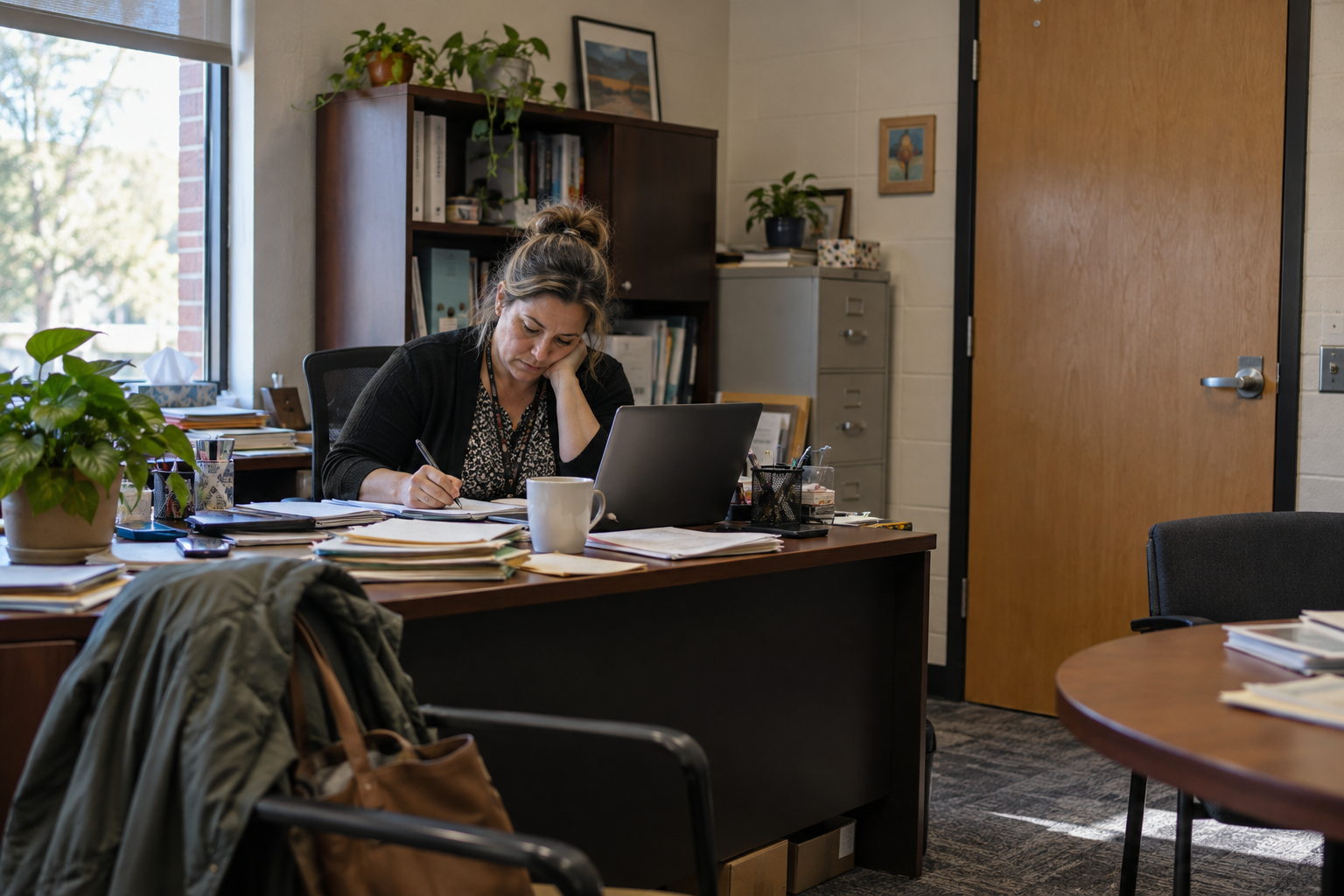
I closed my office door at 10:42 this morning.
I wasn’t in a meeting.
I wasn’t making a confidential phone call. There wasn’t a parent sitting across from me, and I wasn’t dealing with anything that required privacy.
I just closed it.
A few minutes later, someone knocked.
“Are you in a meeting?”
I looked at the papers spread across my desk.
“I’m just finishing something.”
That wasn’t exactly a lie.
There were things to finish. There are always things to finish.
But that wasn’t why I had closed the door.
I closed it because for the first time since I arrived that morning, I wanted twenty minutes in which nobody could see me.
More specifically, I wanted twenty minutes in which nobody could need me.
It had been one of those mornings
Nothing particularly bad had happened.
That’s important.
There hadn’t been a crisis.
Nobody had stormed into my office. No emergency had interrupted the day. There wasn’t one unreasonable person I could blame for making the morning difficult.
It was simply busy in the way school mornings become busy.
Someone needed a signature.
Someone had a question about something we’d already discussed but wanted to make sure they understood correctly.
A teacher stopped by about a concern.
A parent called.
Someone else appeared at the door and began with the familiar words, “Do you have a minute?”
Of course I did.
Or at least that’s what I said.
The minute became ten.
Then someone else needed something.
I walked out of my office to do one thing and was stopped twice before I reached where I was going.
None of those people had done anything wrong.
That’s what makes this difficult to admit.
They weren’t interrupting me because they didn’t respect my time.
They came because part of my job is to be available.
And I’ve worked hard to make sure people feel that they can approach me.
I don’t want teachers standing outside my office wondering whether they’re allowed to come in.
I don’t want staff members afraid to ask questions.
I don’t want a student to think I’m too important to speak to them.
I don’t want parents to feel that the principal is some distant figure hidden behind a door.
I’ve said some version of “My door is always open” more times than I can remember.
Most of the time, I mean it.
But apparently there are also mornings when I desperately want the door to be closed.
I didn’t have anything important to do
That’s the part that made me feel guilty.
If I had been preparing for an important meeting, I wouldn’t have thought twice about closing the door.
If I had been reviewing something confidential, nobody would have questioned it.
If there had been a difficult phone call I needed to make, closing the door would have been perfectly reasonable.
But I wasn’t doing any of those things.
I was answering emails.
Looking through paperwork.
Writing a few notes.
Trying to remember what I had been doing before the last person walked in.
Ordinary work.
Nothing that justified shutting everyone out.
At least, that’s how I thought about it.
I even found myself trying to look busy when I heard someone outside.
I moved a document closer.
Clicked back onto something on my computer.
As though I needed evidence.
As though someone might open the door and catch me doing something unacceptable:
sitting quietly.
There is something strange about reaching a point where you feel you need a professional excuse to be unavailable for twenty minutes.
I do want people to come to me
This is where the confession becomes inconvenient.
Because I don’t want the opposite.
I don’t want to become the principal nobody approaches.
I’ve worked with leaders whose doors felt heavier than they looked.
You learned to calculate whether your question was important enough before knocking. You rehearsed what you were going to say. Sometimes you simply decided it could wait.
I never wanted my office to feel like that.
I still don’t.
Some of the best conversations I’ve had in this job began with somebody appearing unexpectedly.
A teacher dropping by to tell me something that happened in class.
A student wanting to show me something.
A colleague needing to talk through an idea.
Someone sitting down for what I assumed would be a quick conversation and eventually telling me what was actually bothering them.
Those moments matter.
Accessibility matters.
But I am beginning to understand that wanting to be available to people and wanting to be available every minute are not the same thing.
At 10:42 this morning, however, I didn’t have language for that.
I only knew I didn’t want another knock.
It’s rarely the big things
People imagine that the exhausting parts of leadership must be the major problems.
Sometimes they are.
But some days it isn’t the difficult parent, the staffing issue, the serious student concern, or the decision that could affect the entire school.
Sometimes it’s twenty-seven small things.
A question.
A signature.
A clarification.
A message.
A quick conversation.
A request.
Someone standing at the door saying, “Sorry, just one more thing.”
None of them is particularly heavy on its own.
That’s why it’s difficult to explain why, by late morning, you can suddenly feel as though you don’t want to hear your name for a while.
You haven’t done anything dramatic.
You’ve simply been available.
Again.
And again.
And again.
There is a particular kind of tiredness that comes from repeatedly moving your attention from one person’s need to another.
You listen.
You think.
You respond.
Then you reset yourself for whoever comes next.
Sometimes you do that so many times that when there is finally nobody in front of you, it takes a moment to remember what you were thinking about before everyone arrived.
Someone knocked again
It was probably fifteen minutes after the first person.
Three knocks.
Then silence.
I looked toward the door.
For a second, I considered pretending I hadn’t heard it.
Instead I said, “Yes?”
The door opened slightly.
“Sorry. Are you busy?”
There it was again.
The question.
I looked at my screen.
There was an unfinished email open.
A stack of papers beside me.
Several things on my calendar for the afternoon.
So I had an answer available.
“Yes, a little.”
They started backing away.
“It can wait.”
Normally, I would have said, “No, it’s okay. Come in.”
I almost did.
The words were ready.
Then I stopped myself.
“Can I come find you after lunch?”
“Of course.”
The door closed.
Nothing terrible happened.
They weren’t offended.
The school didn’t stop functioning.
Whatever they needed could wait.
I sat there for a moment feeling strangely uncomfortable about what I had just done.
I had asked someone to wait.
That was all.
Why did it feel like I had broken some unwritten rule?
Maybe I helped write the rule
I suppose that’s possible.
Maybe after years of telling people that my door is open, I started believing that closing it required justification.
Maybe I became so accustomed to being the person people could reach that being temporarily unreachable felt selfish.
There is also something flattering about being needed.
I don’t say that proudly.
But it’s there.
People come to you because they believe you can help.
They ask because they trust your judgment.
They bring problems because your position gives you some ability to do something about them.
Being needed can make you feel useful.
And being useful can become part of how you measure whether you’re doing your job well.
Until one morning you find yourself staring at a closed door, hoping nobody knocks, and wondering what that says about you.
I’m not sure it says anything particularly dramatic.
I don’t think it means I’ve stopped caring.
I don’t think it means I’ve become inaccessible.
I don’t think it means I chose the wrong profession.
Maybe it simply means there are limits to how continuously one person can be available.
Even if that person’s name is on the office door.
The twenty minutes I apparently needed permission to have
Eventually I went back to the email I’d been trying to write.
I finished it.
Then another.
I reviewed the papers beside me.
For a few minutes, I did one thing at a time.
Nobody was waiting for an immediate response.
Nobody was watching my face while I tried to understand what they needed.
Nobody was asking me to decide.
The office wasn’t silent. I could still hear the school outside.
Footsteps.
Voices.
A door opening somewhere down the corridor.
The normal sounds of a place full of people.
I wasn’t escaping any of it.
I was still there.
I had simply put a door between myself and everyone else for a little while.
And apparently I needed that more than I wanted to admit.
After lunch, I found the person I’d asked to wait.
We talked.
It took about seven minutes.
The issue wasn’t urgent.
They weren’t upset that I hadn’t spoken to them immediately.
By mid-afternoon, my door was open again.
People came in.
I answered questions.
Someone needed a signature.
Someone wanted my opinion.
There was another “Do you have a minute?”
And this time, I did.
I don’t know whether I’ll close the door again tomorrow.
Probably not.
But I suspect there will be another morning eventually when I look at that door and want twenty minutes on the other side of it.
Maybe next time I won’t need to pretend I’m busier than I am.
Maybe being unavailable for a few minutes doesn’t always need a better explanation than this:
I needed a few minutes.
So I took them.
Share Your Thoughts