
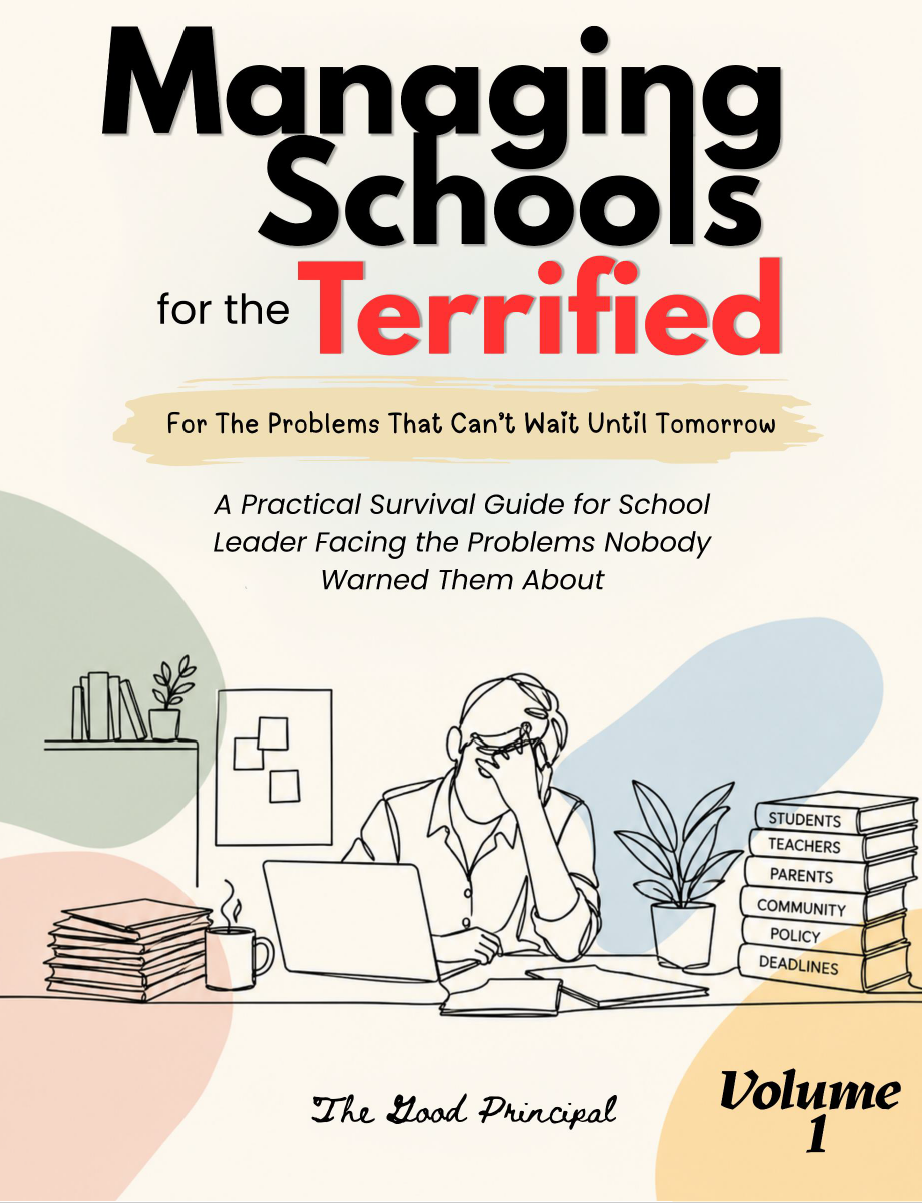
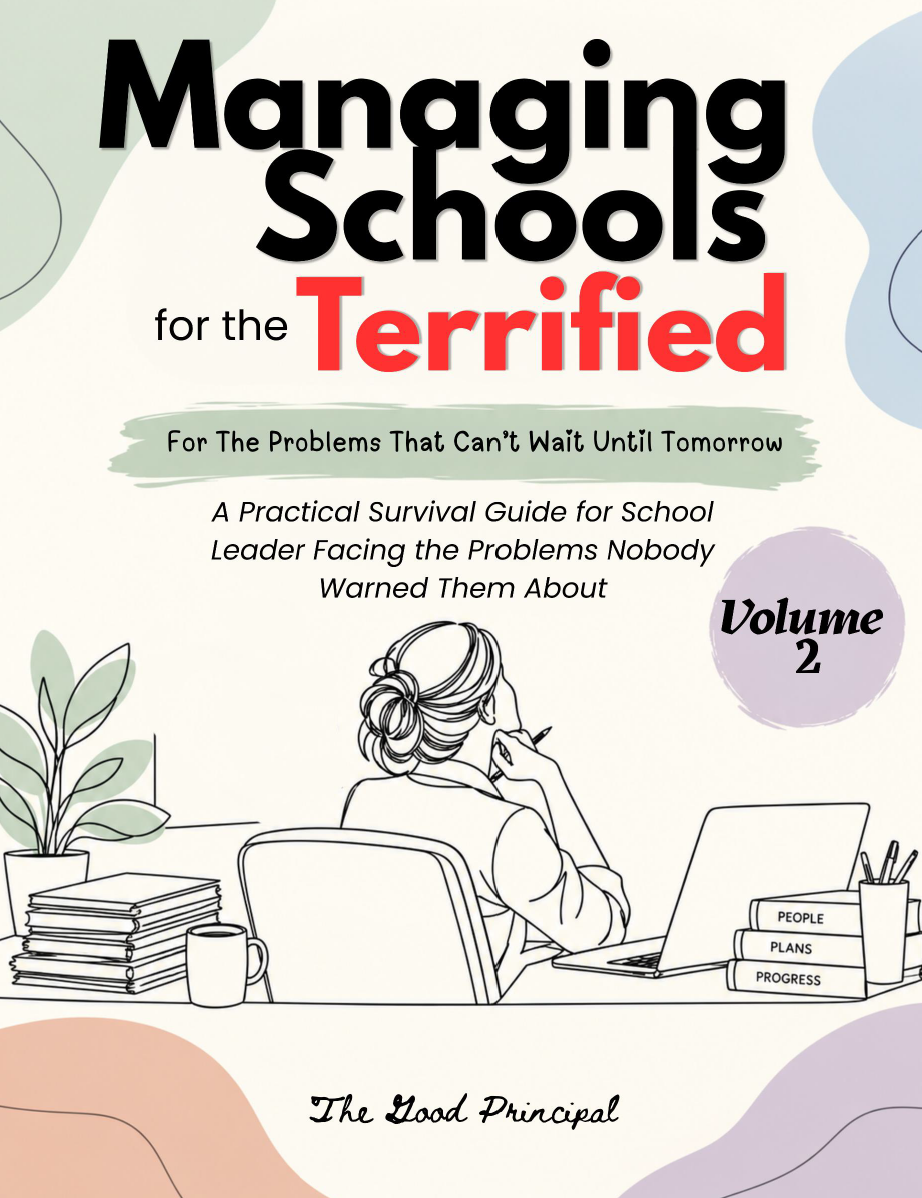
Managing Schools for the Terrified (Volume 1 & 2)
For the Problems That Can’t Wait Until Tomorrow
A Practical Survival Guide for School Principals
School leadership rarely gives you the luxury of solving one problem at a time.
A parent is upset.
A teacher is frustrated.
A report is due.
A student issue has escalated.
The district wants something immediately.
And somehow, all of it has become your problem.
Managing Schools for the Terrified was written for that version of leadership.
Not the theory.
Not the ideal school.
The actual work waiting for you when you open your office door.

Nobody warned you how much of the job would begin with:
“Principal, do you have a minute?”
A teacher is upset.
A parent wants to speak with you.
Two staff members aren’t getting along.
Someone ignored a decision you already explained.
A problem you thought was settled yesterday has somehow returned this morning.
There’s paperwork waiting.
Someone above you needs something.
Someone below you needs something else.
And somewhere between all of them, you’re supposed to know what to do.
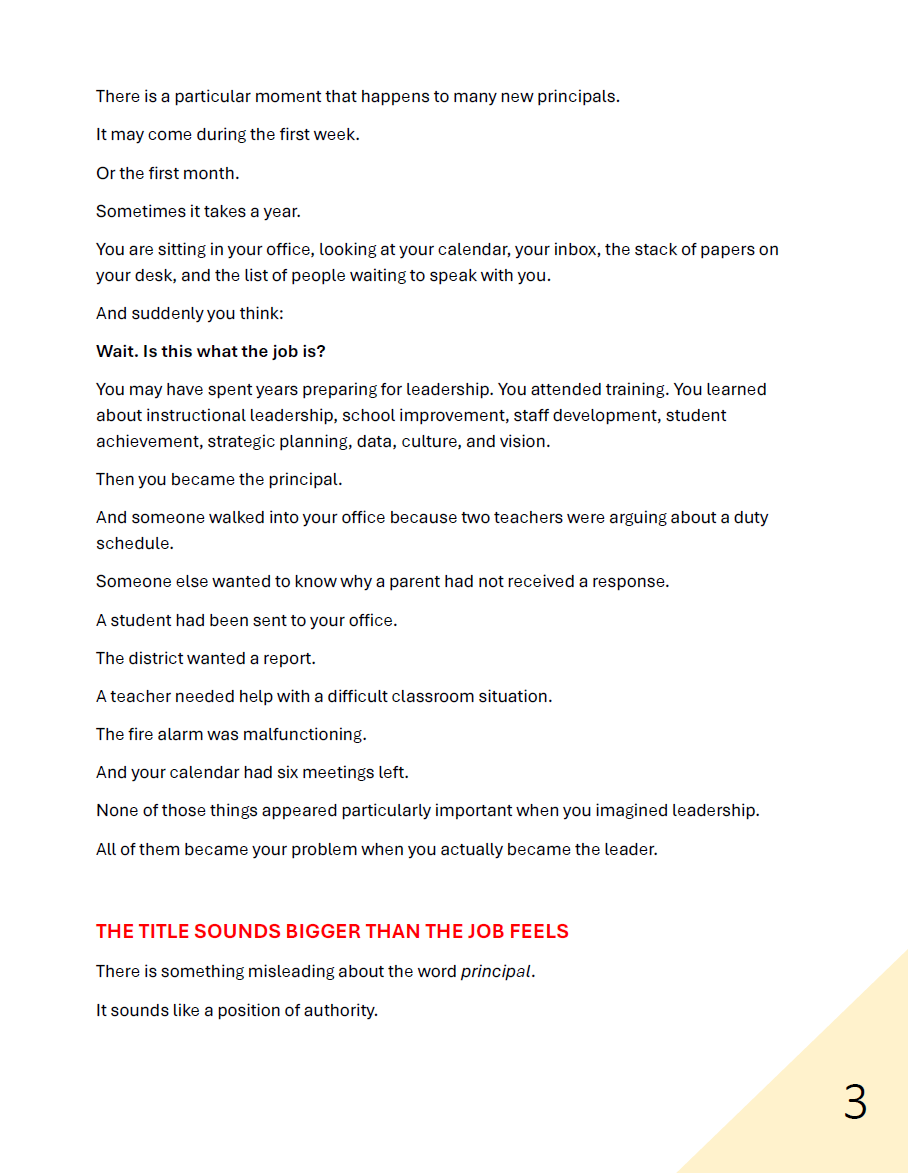
You probably learned about leadership.
You may have attended seminars, completed courses, read policies, studied management, and listened to experienced school leaders talk about best practices.
But at 9:17 on a Tuesday morning, with an angry parent outside your office and a teacher waiting behind them…
“Transformational leadership” isn’t the first thing going through your mind.
You’re thinking:
What do I do now?

Some school problems don’t need another theory.
They need an answer before lunch.
There is a version of school leadership that looks very organized on paper.
Set the vision.
Build the culture.
Develop your people.
Improve teaching and learning.
Lead with purpose.
All of that matters.
Then there is the version where someone knocks on your door and says:
“We have a problem.”
That’s where principalship becomes very real, very quickly.
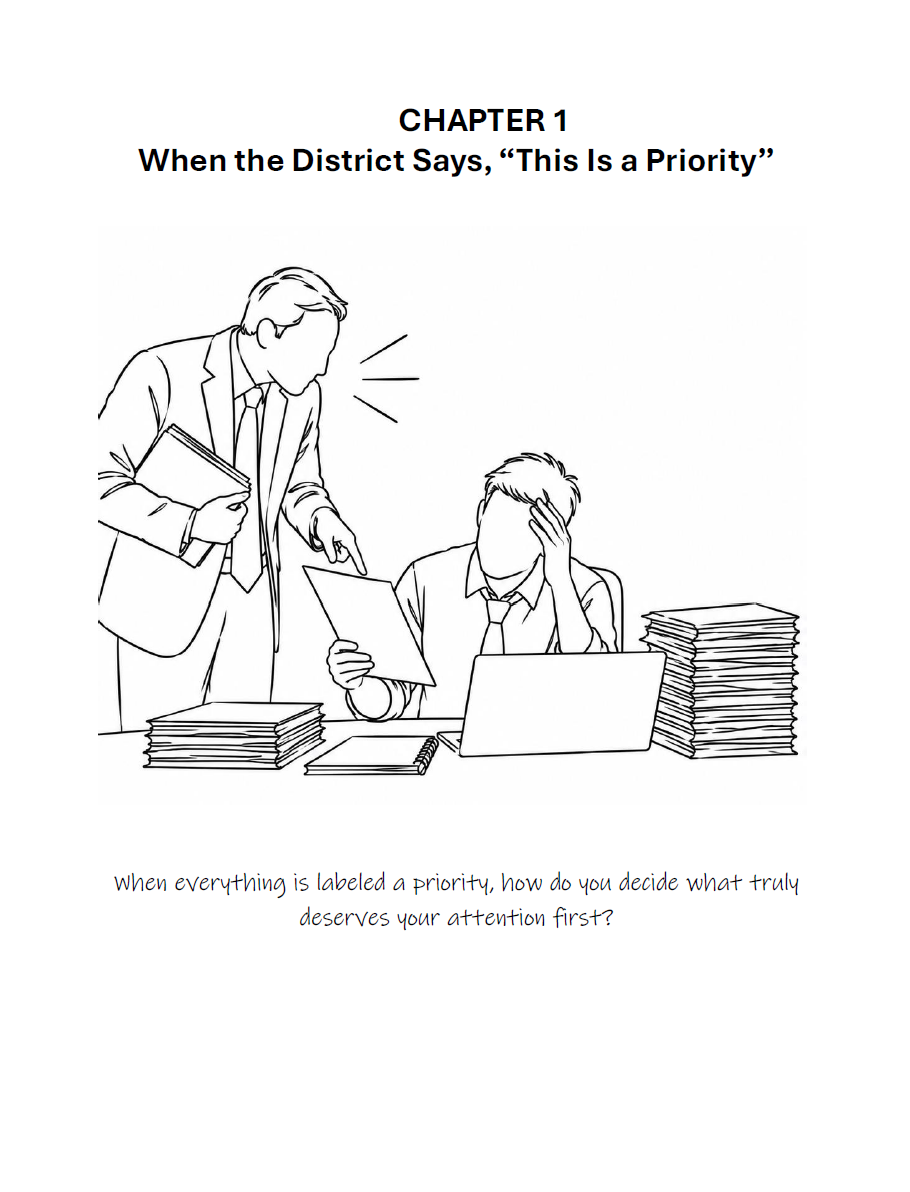
What do you say when a teacher challenges you in front of other staff?
How do you correct someone who used to be your colleague without turning the relationship into a war?
What do you do when a parent is furious—and isn’t completely wrong?
How do you say no without spending the next three days wondering whether everyone now thinks you’re the villain?
What happens when two adults bring you a conflict and both expect you to take their side?
And what do you do when you’ve handled the people problem, answered the email, finished the meeting, completed the report…
and somehow your actual work is still waiting?
These aren’t unusual leadership failures.
This is the job.

The hardest problems are rarely the ones with an obvious answer.
Policies can tell you what is permitted.
Procedures can tell you what should happen next.
Leadership frameworks can help you understand how good organizations work.
But real school problems are often messier than that.
The difficult teacher is also excellent with students.
The angry parent has a legitimate point—but is expressing it badly.
The employee you need to correct is someone you’ve known for years.
The decision that’s best for the school may disappoint someone you genuinely like.
The instruction from above still has to be implemented even though your teachers are already overwhelmed.
And sometimes every available option comes with a consequence.
That’s where the problem changes.
You aren’t simply asking:
“What is the rule?”
You’re trying to work out:
What actually matters here?
What am I missing?
What happens if I respond too quickly?
Which part of this situation is mine to solve?
What response makes sense when no response keeps everyone happy?
That’s where leadership stops being something you understand in principle.
It becomes judgment.
And eventually everyone stops talking.
Looks at you.
And waits.
“So… what are we going to do?”
That is why Managing Schools for the Terrified exists.
A Practical Survival Guide for School Principals
Managing Schools for the Terrified was written for the part of school leadership that often happens between the leadership seminar and the next crisis.
It isn’t another academic textbook about management.
It isn’t a collection of inspirational leadership quotations.
And it isn’t written for an imaginary principal working in a perfectly cooperative school.
It’s for the principal dealing with actual people, actual pressure, actual conflict, and actual work that needs an answer.
The two-volume set takes the situations that can make a school leader quietly think:
“Nobody taught me what to do with this.”
And helps you slow the situation down long enough to think about what is really happening.
What matters.
What may make things worse.
What deserves your attention.
What may need a boundary.
And what your next move could be.
Not by pretending there is one perfect script for every school.
But by helping you think more clearly when the situation in front of you is anything but clear.
Not from the stage.
From inside the office.

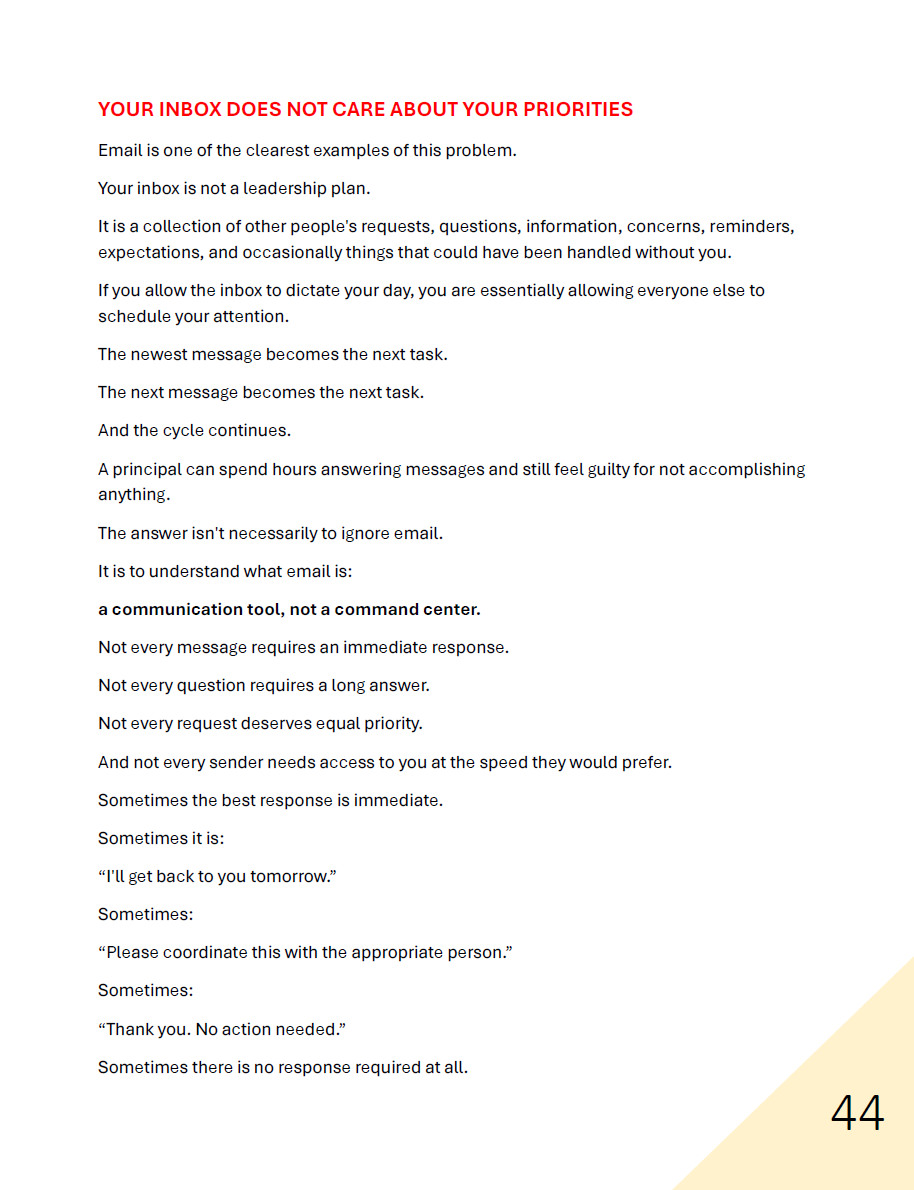
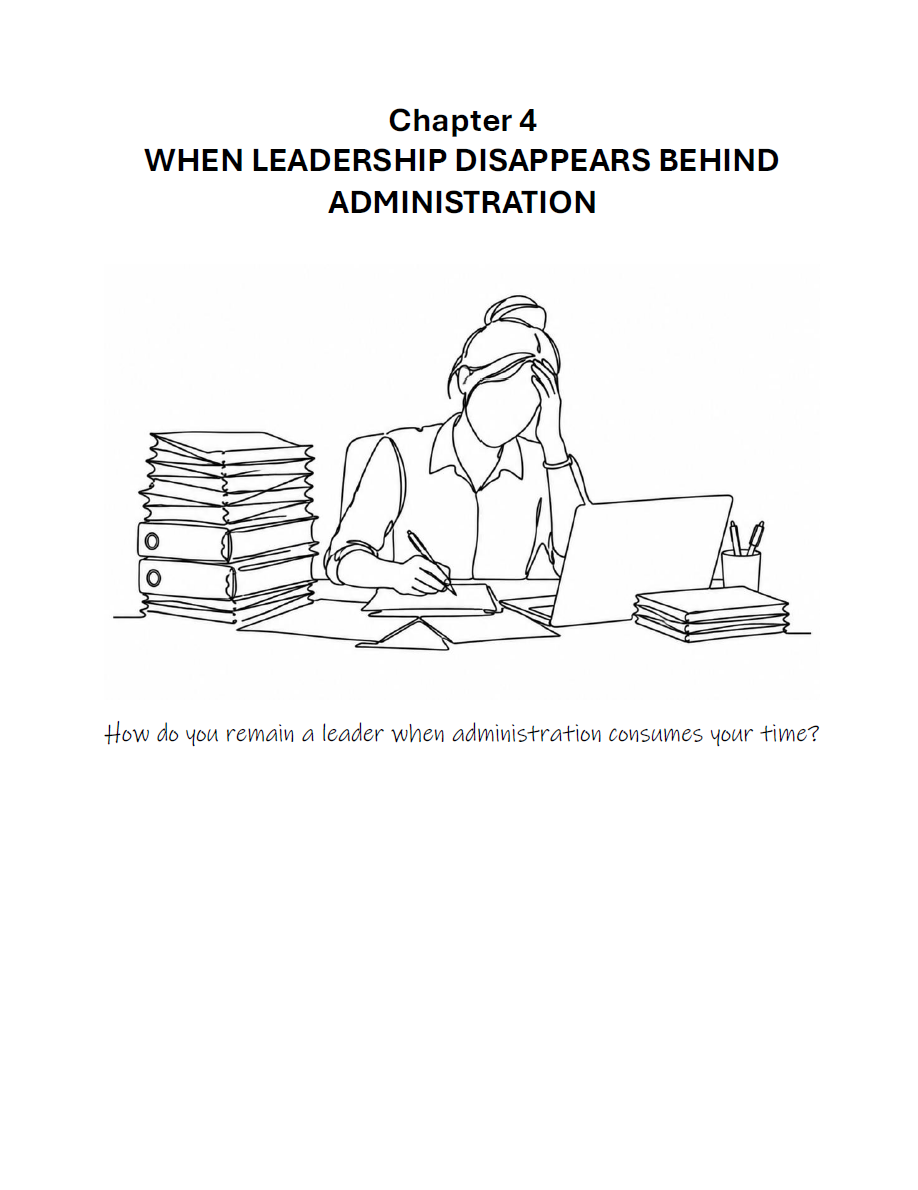
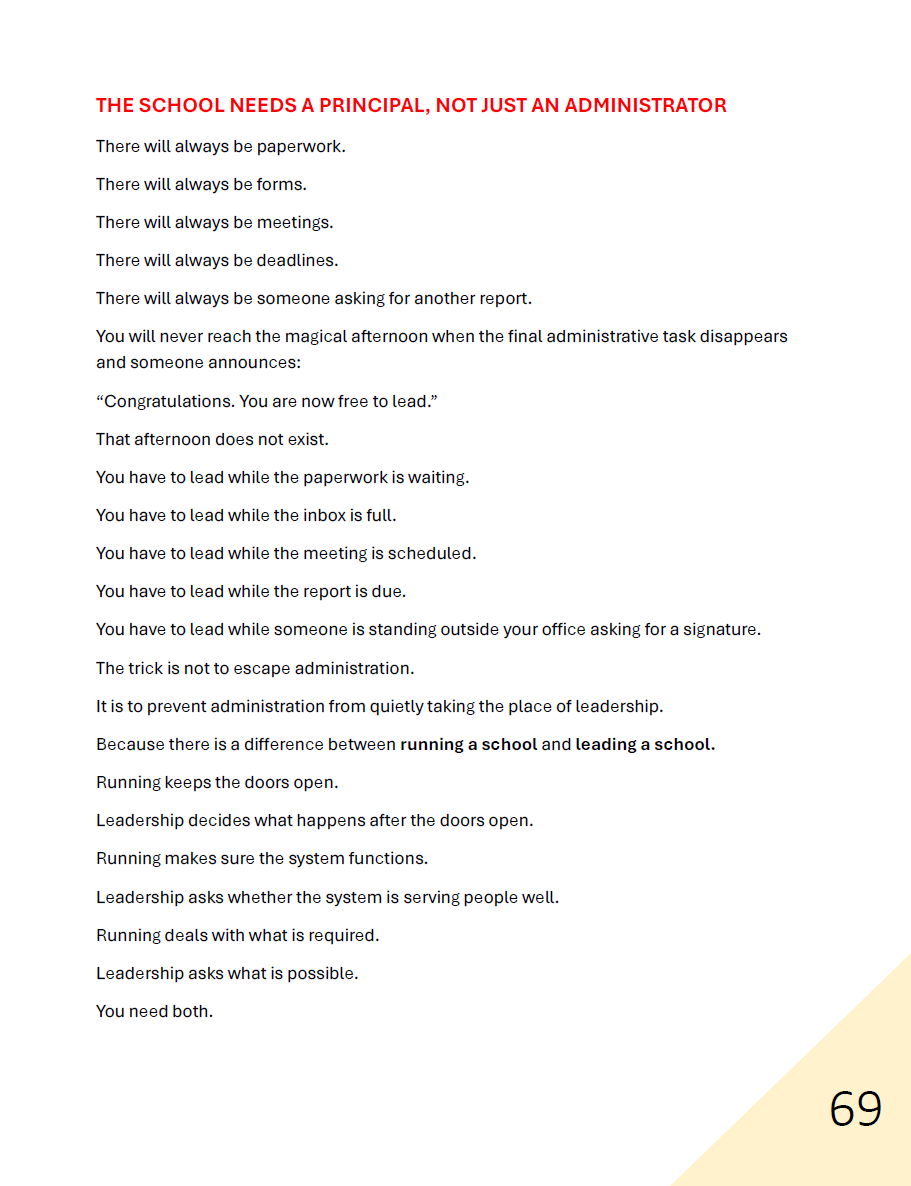

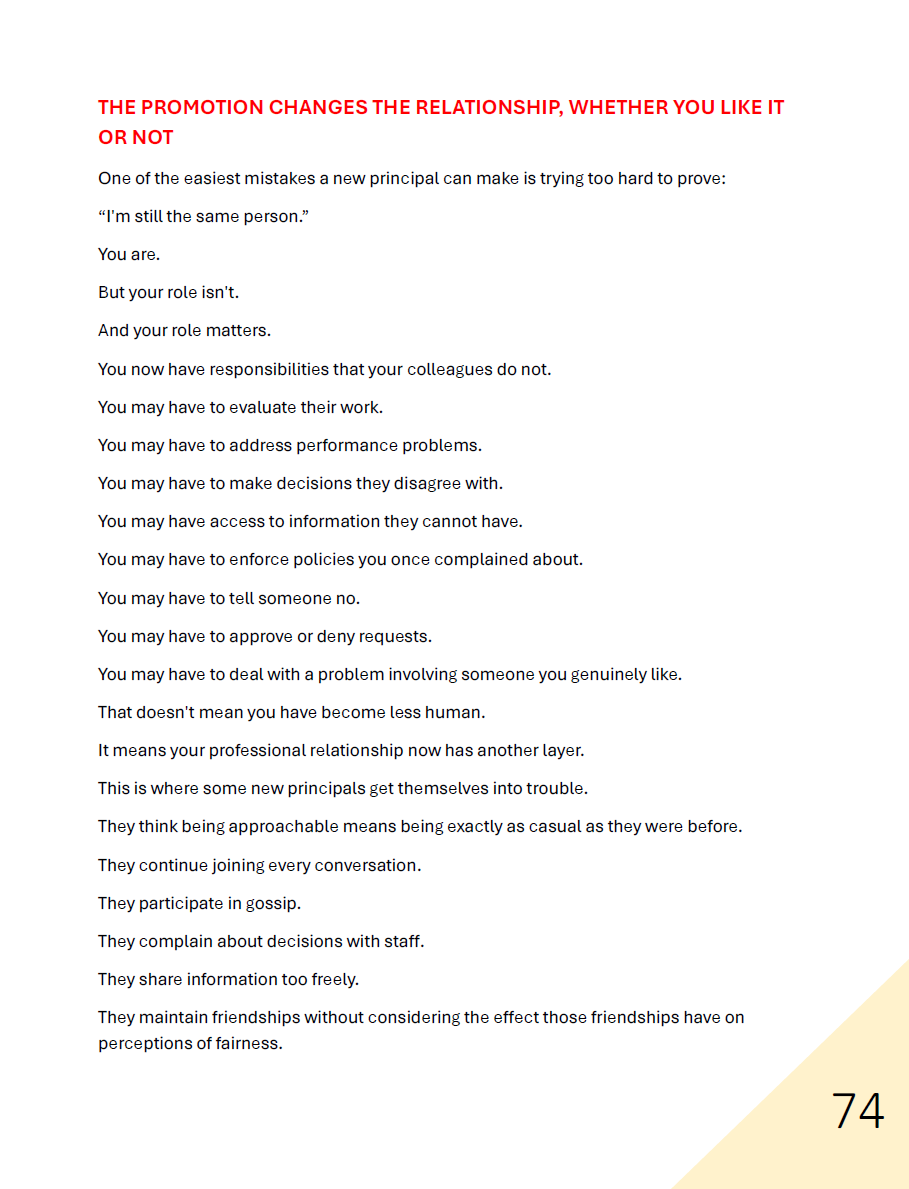


Volume 1 begins where the job usually gets real.
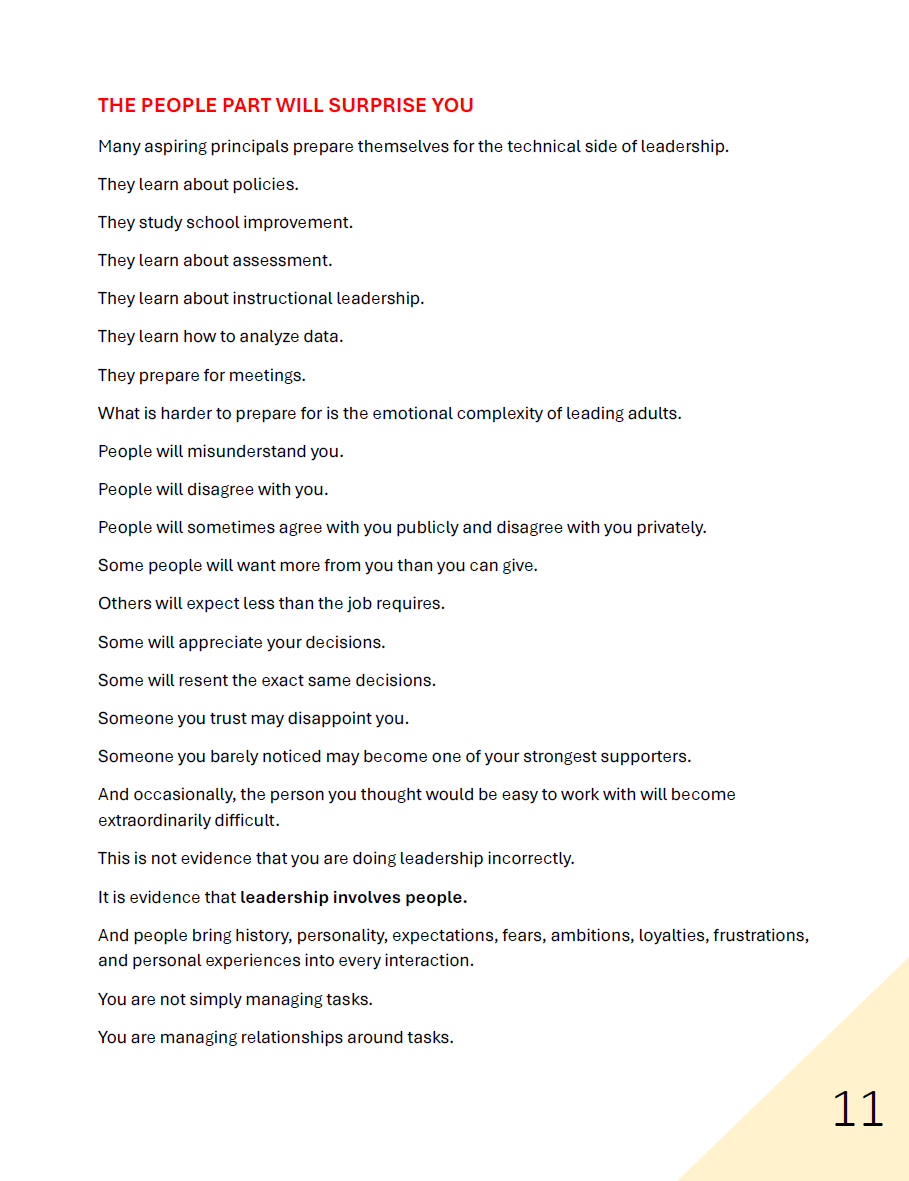
The people.
You discover very quickly that schools aren’t difficult because nobody knows what a lesson plan is.
Schools are difficult because they are full of human beings.
Human beings have histories.
Personalities.
Friendships.
Grudges.
Expectations.
Bad days.
Different interpretations of the same conversation.
And now you’re leading them.
Some may have been your peers.
Some may be older than you.
Some may have wanted the position you now occupy.
Some will support you.
Some will test you.
Some may smile during the meeting and disagree with you five minutes later somewhere else.
And you still have to lead the school tomorrow morning.
Volume 1 spends time in this territory.
The difficult employee.
Adults who stop behaving like adults.
The impossibility of keeping everybody happy.
Learning to say no.
The angry parent.
The student problem that keeps returning.
The moments when the school seems to arrive at your office all at once.
The goal isn’t to give you a clever sentence that magically fixes difficult people.
It’s to help you understand what kind of situation you’re actually dealing with before you decide how to respond.
Because the same leadership response doesn’t belong in every conflict.
And sometimes the most important thing you can do before saying something is understand what problem you’re really trying to solve.
Not because people are the enemy.
Because people are the work.




Volume 2 begins where many principals quietly start feeling the weight.
The pressure.
Leadership doesn’t only come from below.
Sometimes you’re standing in the middle.
Teachers need you to understand what they’re carrying.
Parents expect answers.
Students need decisions.
The school needs direction.
And people above you have expectations of their own.
Deadlines don’t disappear because your staff is exhausted.
Reports don’t care that you’ve already had three difficult conversations today.
A new instruction can arrive while you’re still trying to implement the previous one.
And somehow you’re expected to absorb the pressure without simply passing all of it down.
This is another part of leadership that doesn’t always fit neatly into a framework.
How do you carry responsibility without allowing the job to consume everything?
How do you keep functioning when the work never seems completely finished?
How do you know which problem needs your attention—and which one can survive without you for an hour?
How do you remain useful to everyone else without gradually becoming useless to yourself?
Volume 2 goes further into the pressure from above, the parts of the job nobody prepares you for, and the question every principal eventually has to confront:
How do I survive this job without becoming someone I don’t recognize?

This is not a book about becoming the perfect principal.
There isn’t one.
And pretending there is can make the job harder.
You’re going to have conversations you wish you’d handled differently.
You’re going to make decisions with incomplete information.
Someone will misunderstand you.
You’ll occasionally say yes when you should have said no.
You’ll probably take something personally that you later realize wasn’t entirely about you.
And there will be days when the person with the principal’s title doesn’t feel particularly certain at all.
This set isn’t designed to turn you into a flawless leader.
It’s designed to help you become a more prepared one.
Someone who gets better at recognizing what kind of problem is actually sitting in front of them.
Someone who pauses before reacting.
Someone who understands that not every conflict needs the same response.
Someone who notices the difference between a problem that needs solving, a conversation that needs having, a boundary that needs holding, and something that simply doesn’t deserve as much of their attention as it is currently receiving.
Someone who can make an imperfect decision without spending the entire evening mentally putting it on trial.
And someone who gradually learns:
Not everything that reaches the principal’s office deserves to live in the principal’s head all night.
These are not two books you have to read once and put away.
You can read them straight through.
But that isn’t the only way they’re meant to be useful.
Because three months from now, you may have a completely different problem.
A difficult employee.
A parent who arrived angry.
A colleague who doesn’t seem to respect your new role.
A decision everyone wants you to make.
A situation where being understanding and holding a boundary seem to be pulling you in opposite directions.
A day when you’re wondering why everything eventually becomes your problem.
And you may find yourself thinking:
“There has to be something in here about this.”
That’s when you return.
Not because the book can know every detail of your school.
And not because any chapter can replace your professional judgment.
But because when you’re already inside a difficult situation, it helps to have something that reminds you what to consider before you make your next move.
This isn’t meant to sit perfectly on a digital bookshelf.
Keep it where you can open it beside the problem you’re actually dealing with.
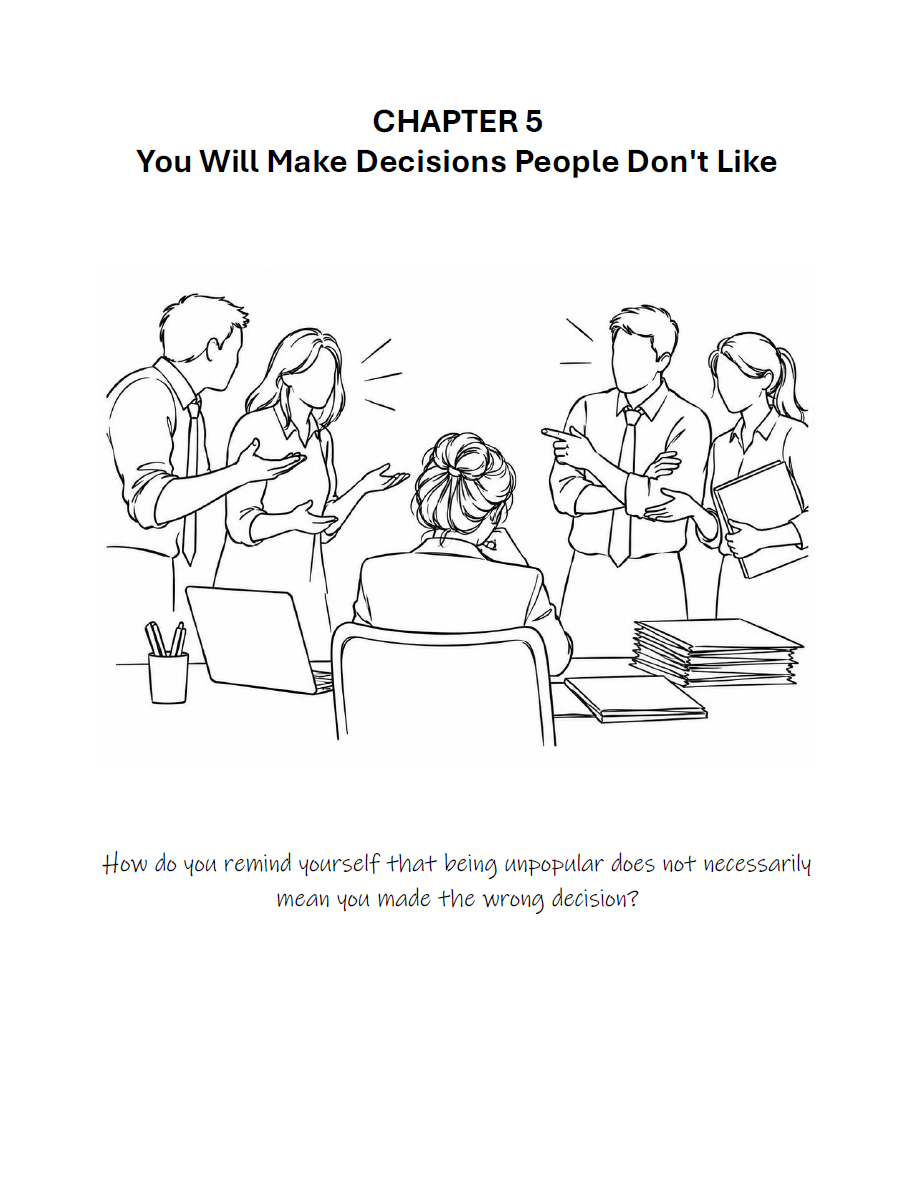
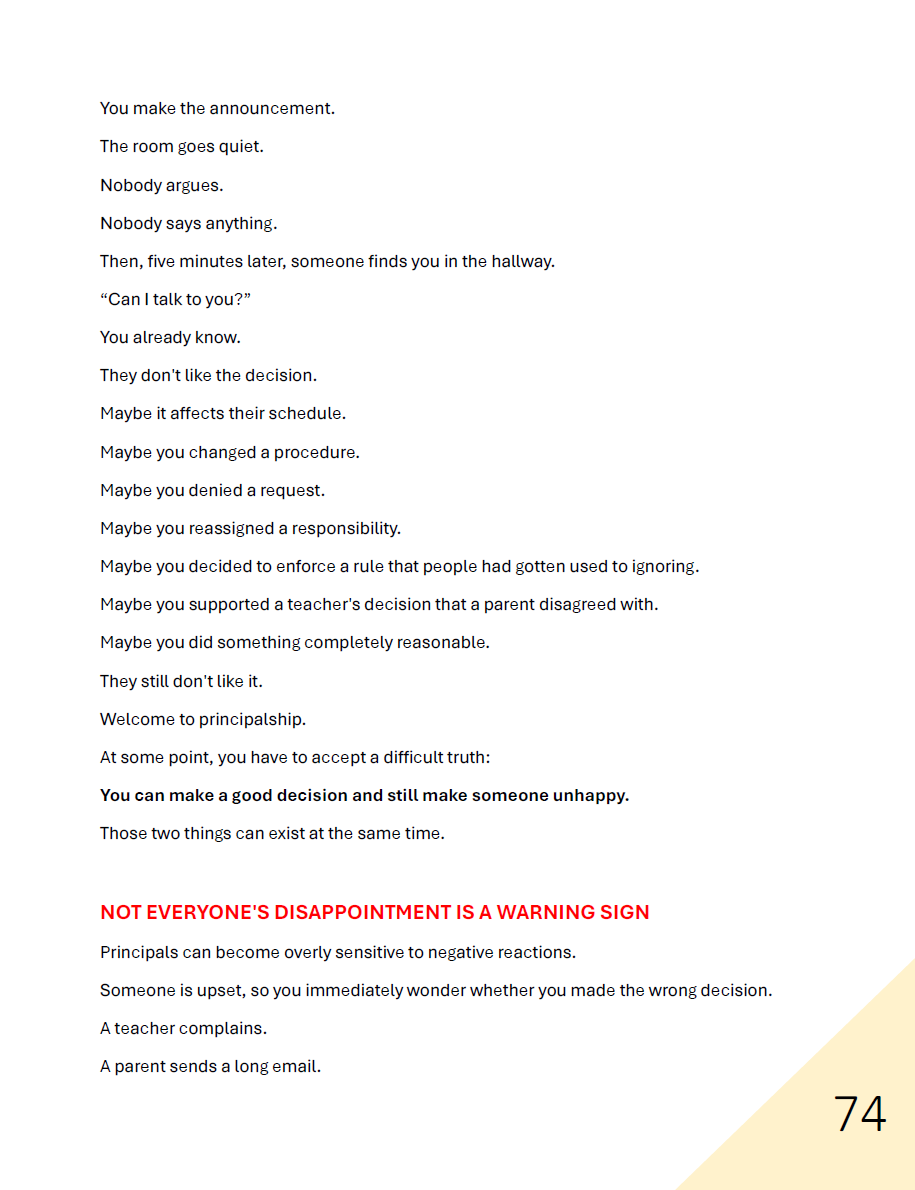
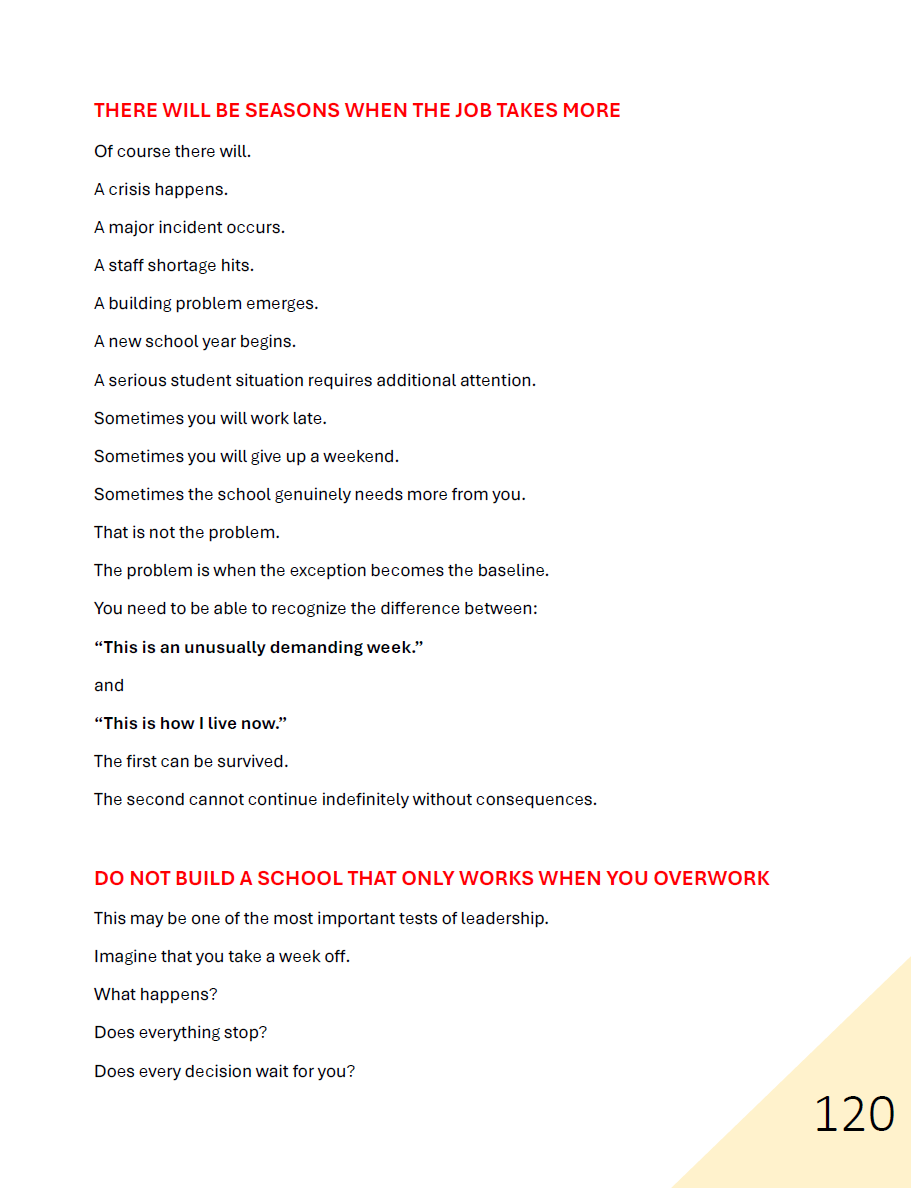
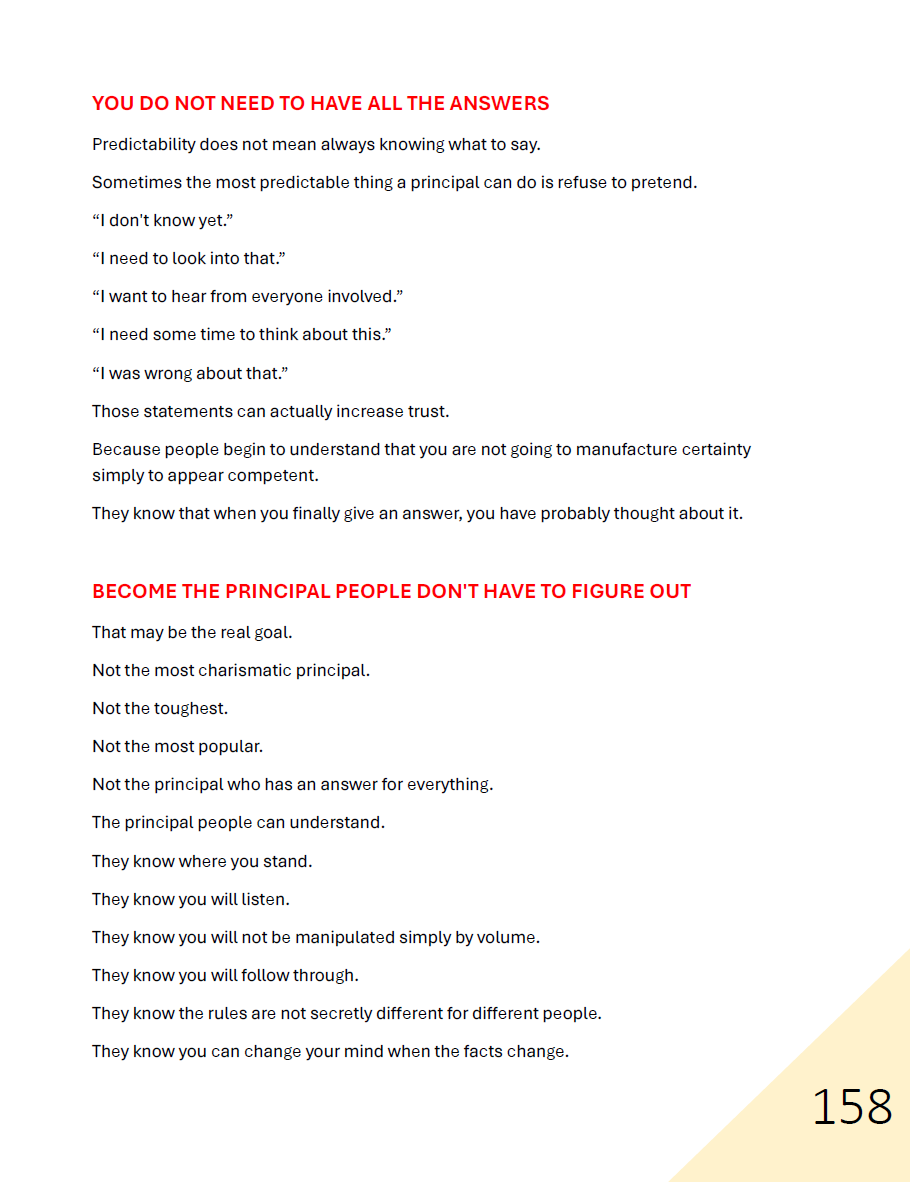
[PRODUCT PREVIEW — Actual interior spreads showing a recognizable school problem, the practical discussion, and the kind of guidance the reader receives]
A quick search can give you an answer.
The harder part is knowing whether it fits the situation in front of you.
You can search how to handle an angry parent.
You can look up strategies for difficult employees.
You can ask another principal what they would do.
You can even find ten different answers in ten minutes.
The difficulty isn’t always finding advice.
It’s deciding:
Which advice actually applies here?
Because context changes everything.
The parent may be angry for a legitimate reason.
The difficult employee may also be one of your strongest teachers.
The person challenging your authority may once have been your closest colleague.
The decision that protects one relationship may weaken another.
And a response that worked beautifully for somebody else’s school may be completely wrong for yours.
That’s why these books are not built around pretending there is one universal script.
They give you a school-specific place to think through the kinds of situations principals repeatedly face—so you’re not beginning from zero every time something difficult lands in your office.
Information is easy to find.
Judgment is what you have to build.
Who are these books for?
For the newly appointed principal who is discovering that having the position and feeling prepared for the position are two very different things.
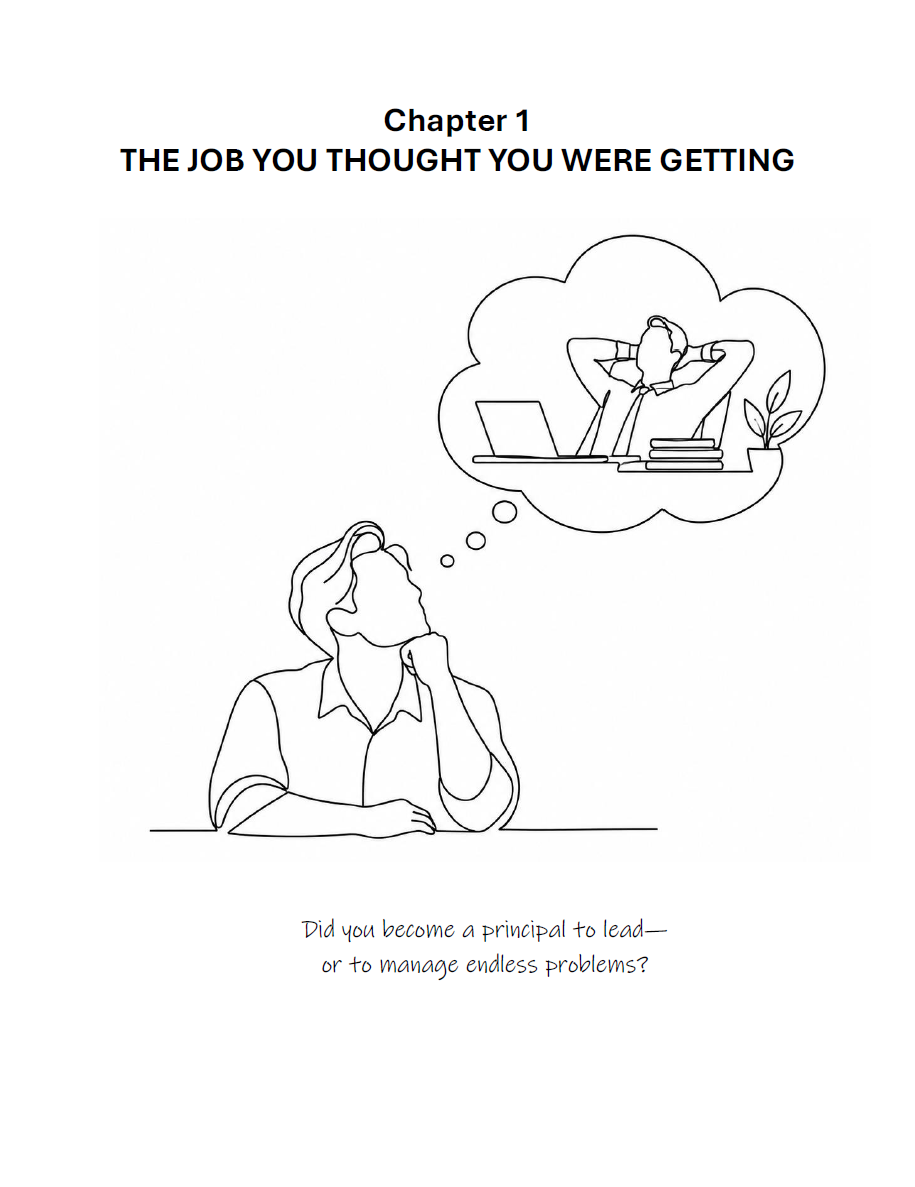
For the school head who occasionally closes the office door and thinks:
“What am I supposed to do with this?”
For the experienced principal who knows the job but still encounters situations that are difficult because people are complicated.
For the aspiring school leader who wants to understand what managing a school actually feels like beyond leadership theory.
And for the principal who doesn’t necessarily need another qualification.
You need something useful when the school becomes messy.
Because sometimes the problem isn’t that you don’t know enough about leadership.
You know relationships matter.
You know communication matters.
You know culture matters.
You know you should listen.
You know you should be fair.
The difficult part is what happens when those principles collide.
Listen—but make the decision.
Be understanding—but hold the boundary.
Support your teachers—but protect students.
Maintain relationships—but correct poor behavior.
Follow expectations from above—but don’t crush the people below you.
Be available—but somehow still finish your own work.
That’s where leadership stops being a collection of principles and becomes judgment.
And judgment gets better when you have somewhere to think through the situations that keep testing it.
That’s the value of these books.
Not memorizing a script.
Not pretending every problem has one correct response.
Not giving your professional judgment away to somebody else’s answer.
But helping you approach familiar school problems with more context, more perspective, and a clearer sense of what deserves your attention before you act.
The goal isn’t to make school leadership easy.
It won’t be.
The difficult employee may still be difficult.
Parents will still get angry.
People will still disagree with you.
Deadlines will still arrive at inconvenient times.
And occasionally something will happen at 8:05 in the morning that completely destroys the day you planned at 7:45.
But fewer situations need to feel completely unfamiliar.
You can begin to think:
I’ve seen something like this before.
I know what matters here.
I know what I should probably avoid doing.
I know what I need to think about before I respond.
I know what my next move can be.
Sometimes that is exactly what a principal needs.
Not another ten-point leadership model.
A next move.
Some problems can wait for your next seminar.
Others will be sitting outside your office tomorrow morning.
That’s why these books were written differently.
For the conversations nobody rehearsed with you.
The adults nobody taught you how to manage.
The decisions where every option has a consequence.
The pressure coming from both directions.
The work that somehow never finishes.
And those occasional moments when you wonder whether everybody else received a principal’s manual that somehow never reached your desk.
They didn’t.
Most school leaders learn a great deal of this by living through it.
Managing Schools for the Terrified gives you somewhere to turn while you do.
Read it before the problem.
Return to it when the problem arrives.
And over time, let the situations that once made you think:
“What am I supposed to do with this?”
become situations you are better prepared to think through.
For the problems that can’t wait until tomorrow.
You don’t have to know everything.
You don’t need a perfect response every time.
And you certainly don’t need another book making you feel inadequate because leadership looks effortless on its pages.
You need something more useful than that.
Something you can return to when:
The parent is already waiting.
The meeting starts in ten minutes.
The employee needs an answer today.
Two people expect you to take their side.
The instruction from above doesn’t fit neatly with the reality below.
Or everyone wants something from you at once.
Sometimes the most useful leadership question isn’t:
“What does the theory say?”
It’s:
“What do I need to understand before I decide what to do next?”
Managing Schools for the Terrified
Volumes 1 & 2
A Practical Survival Guide for School Principals
For the Problems That Can’t Wait Until Tomorrow.
You Don’t Have to Figure It All Out Alone.
The next knock, difficult conversation, or unexpected problem won’t wait until you feel ready. Get practical guidance to help you handle everyday school leadership—one situation, one decision, one school day at a time.
- Instant download after successful payment
- PDF + EPUB formats included
- Read on your preferred device—laptop, phone, tablet, or compatible e-reader
- Digital product only—no physical book will be shipped


Contact Us
You don’t need another person telling you to lead harder. Sometimes you need something that understands what the job actually feels like.