
Should I Still Be A Principal?
A Private Guide for School Leaders Who Are No Longer Sure They Want the Job
There is a question many school leaders think about long before they are willing to say it out loud.
Do I still want to do this?
Not:
Am I capable?
Not:
Am I a good principal?
Not even:
Can I keep going?
A harder question.
Do I still want this life?
You may still care about the school.
You may still be good at the work.
People may still respect you.
Your staff may still depend on you.
And yet something inside you may have started asking whether you want to keep doing this for another five years.
Or ten.
Or until retirement.
Should I Still Be a Principal? was written for that question.
Not to persuade you to stay.
Not to encourage you to leave.
But to help you understand what you are actually feeling before you make a decision that deserves more than one exhausted evening.

A Private Guide for School Leaders Who Are No Longer Sure They Want the Job
This book was written for principals and school leaders who have reached a question they may never have expected to ask.
Not:
Can I do this job?
You’ve already answered that.
The question now is:
Do I still want to?
This isn’t a book trying to persuade you to resign.
It isn’t a book trying to convince you to stay.
And it isn’t another collection of strategies for becoming more resilient so you can tolerate anything indefinitely.
It’s a private place to examine what your uncertainty may actually be telling you.
Before you make a decision.
Before you dismiss the thought.
And before another year passes simply because continuing was easier than deciding.




Because “I want out” can mean more than one thing.
Sometimes it means:
I need rest.
Sometimes:
Something about the way I’m doing this needs to change.
Sometimes:
This school or situation is no longer right for me.
Sometimes:
I still want leadership, but perhaps not like this.
And sometimes it really does mean:
I think this chapter of my life may be finished.
The problem is that when you’re exhausted, frustrated, or overwhelmed, those possibilities can blur together.
So the book doesn’t rush you toward an answer.
It slows the question down.
What exactly are you tired of?
The workload?
The conflict?
The expectations?
The loss of time?
The emotional responsibility?
The particular environment you’re leading in?
Or the role itself?
What would you miss if you left?
What would you feel relieved to put down?
What parts of yourself have grown inside this position?
And what parts have been waiting outside it?
These aren’t questions to answer casually.
Because the goal isn’t simply to escape a difficult month.
It’s to understand what you’re actually trying to move toward—or away from.
You are allowed to question a life you once chose.
The person who accepted the position years ago made the best decision they could with what they knew and wanted then.
That decision mattered.
It shaped you.
It gave you experiences, relationships, responsibilities, accomplishments, failures, and lessons you couldn’t have had from outside the office.
But choosing something once doesn’t automatically answer the question forever.
People change.
Priorities change.
Families change.
Energy changes.
Ambitions change.
Definitions of a good life change.
You can honor the person who wanted this position without requiring the person you are now to want exactly the same things.
And you can question the job without immediately leaving it.
Reflection is not resignation.
Sometimes questioning a role leads you back to it with greater clarity.
Sometimes it leads somewhere else.
The point is to find out which is true for you.
Who is this book for?
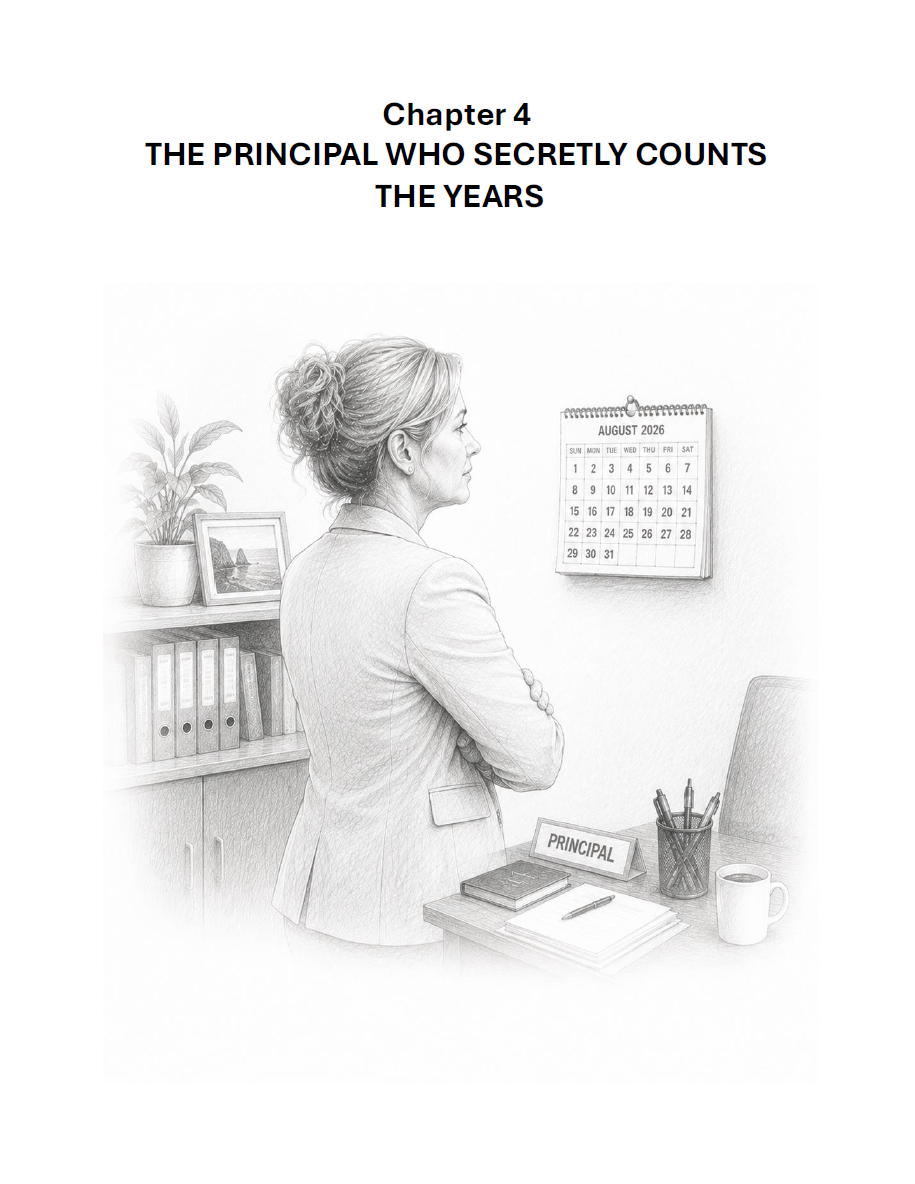
For the principal who has started quietly counting how many years are left.
For the school leader who occasionally searches for jobs they have no immediate intention of applying for.
For the person who still cares about the school but wonders whether caring is enough reason to stay.
For the principal who has become tired of being needed by everyone.
For the leader who feels guilty even imagining another life.
For someone who has thought:
“Maybe next year will feel different.”
More than once.
And for the principal who isn’t miserable at all—
but has begun wondering whether being fine is enough reason to keep choosing the same future.
You don’t need to have decided to leave.
You only need to have started wondering whether you want to stay.
There may be more than two possible futures.
When you’re exhausted, the decision can feel brutally simple:
Stay.
or
Leave.
But life may offer more possibilities than that.
Perhaps you stay—but differently.
Perhaps you remain in educational leadership while changing where or how you lead.
Perhaps you step away temporarily.
Perhaps you prepare gradually for something else.
Perhaps you rediscover something in the role that had been buried under exhaustion.
Or perhaps you eventually decide that principalship has given you what it was meant to give you—and it’s time to build another version of your life.
You don’t have to know which future is yours before opening the book.
That’s what you’re trying to understand.
[PRODUCT PREVIEW — Interior reflection spread / decision-focused pages]
And yes, there is a life on the other side of the office.
That sentence can be surprisingly difficult to imagine.
When you’ve been a principal long enough, the position starts attaching itself to your identity.
People introduce you by the title.
Your routines revolve around the school.
Your expertise has been built around leadership.
Your professional network knows you as a principal.
So leaving can create another uncomfortable question:
Who am I if I’m not this anymore?
That’s not a small concern.
But neither is staying somewhere solely because you no longer know who you would be outside it.
There was a person before the title.
There can be a person after it too.
Not necessarily a better life.
Not necessarily an easier one.
A different one.
And understanding whether you actually want that difference is part of the decision.
But don’t romanticize leaving either.
Another life will have problems.
Another job may frustrate you.
Leaving leadership doesn’t guarantee peace.
Changing careers doesn’t automatically restore energy, purpose, time, or happiness.
And sometimes what looks like:
“I need a different life”
is actually:
“I need this life to stop operating this way.”
That’s why this decision deserves more than fantasy.
You need to look honestly at both sides.
What staying may require.
What changing may cost.
What leaving could give you.
What leaving could take away.
What might improve if your circumstances changed.
And what might follow you wherever you go.
The goal isn’t to make leaving look brave.
Or staying look loyal.
The goal is to make either decision more honest.
This book will not give you permission to leave.
You don’t need a book to grant you that.
And it won’t give you an obligation to stay.
It will give you somewhere to examine the decision without needing to perform certainty for anyone else.
You may finish and realize:
I still want this.
Perhaps the job isn’t finished.
Something about the way you’re living it simply needs to change.
You may realize:
I want to stay for now—but not like this.
Boundaries, expectations, environment, support, or priorities may need to shift.
You may discover:
I need time before I decide.
That is also an answer.
Or you may eventually reach:
I think I’m ready for something else.
Not because you failed.
Not because the job defeated you.
Because you’ve looked carefully at what you want the next part of your life to contain.
No outcome is predetermined.
You don’t need certainty.
You need to understand what your uncertainty is trying to tell you.
Perhaps your doubt is asking for rest.
Perhaps it’s asking for change.
Perhaps it’s asking for stronger boundaries.
Perhaps it’s asking you to remember why you chose this work.
Or perhaps it’s asking a question you’ve been postponing because you’re afraid of what the answer might change.
The purpose of this book isn’t to make that question louder.
It’s to help you hear it clearly enough to respond thoughtfully.
Because there is a difference between making a major life decision during your worst week—
and making one after you’ve given yourself enough space to understand what has been building for months or years.
Read this before you make yourself stay.
And before you make yourself leave.
Either decision can be expensive.
Not only financially.
In time.
Relationships.
Identity.
Energy.
Opportunity.
Years.
So before you submit a resignation because today was unbearable—
pause.
And before you commit yourself to another five years simply because leaving feels frightening—
pause there too.
Give yourself somewhere between those two impulses.
Somewhere you can ask:
What am I actually feeling?
What has changed?
What hasn’t?
What do I still want from this work?
What do I want from the rest of my life?
What would I be choosing if nobody expected anything from me?
A decision this personal deserves more than momentum.
You can be good at something and still be finished with it.
And you can question something and discover you’re not finished with it at all.
Both are possible.
That is why the question deserves to be explored instead of immediately answered.
Maybe principalship still belongs in the next chapter of your life.
Maybe it belongs there differently.
Maybe it doesn’t.
You don’t need this book to tell you which.
You need somewhere honest enough to help you find out.
Should I Still Be A Principal?
A Private Guide for School Leaders Who Are No Longer Sure They Want the Job
For principals who don’t need another person telling them to stay strong, keep going, or walk away.
You need enough clarity to decide what comes next for yourself.
Digital Edition · PDF + EPUB
You don’t have to decide today.
But you don’t have to keep avoiding the question either.

Contact Us
You don’t need another person telling you to lead harder. Sometimes you need something that understands what the job actually feels like.