
The Lonely Office
The Hidden Emotional Cost of School Leadership
There is a kind of loneliness that comes with being the person everyone depends on.
People come to your office when something goes wrong.
Teachers bring concerns.
Parents bring frustrations.
Students bring problems.
Supervisors bring expectations.
Your staff looks to you for certainty, even on days when you are not completely certain yourself.
You listen.
You decide.
You reassure.
You solve what you can.
And eventually, the school becomes quiet.
The doors close.
The hallway empties.
And for the first time all day, nobody needs anything from you.
That is often when everything you have been carrying finally catches up.
The Lonely Office was written for that moment.

You spend the entire day surrounded by people.
Teachers stop you in the hallway.
Students need decisions.
Parents ask for answers.
Messages keep arriving.
Someone is waiting outside your office.
Someone else asks if you have a minute.
There are meetings, conversations, questions, problems, requests.
Some days, you barely get a moment alone.
And yet—
this can be one of the loneliest jobs in the school.
Not because nobody is around.
Because there are fewer and fewer people you can speak to without first thinking about what your words might become.

There are things you could say when you were a teacher that feel different now.
You used to be able to sit beside a colleague and say:
“That meeting was terrible.”
“I don’t know what they’re thinking.”
“I’m exhausted.”
“I have no idea what to do about this.”
Then you became the principal.
Now the teacher beside you may be someone you supervise.
The frustration you want to express may involve someone you’re responsible for leading.
The decision you’re questioning may be one everyone expects you to defend tomorrow morning.
And even when you trust someone, a second thought sometimes appears:
Should I really say this?
So you don’t.
You listen instead.
You reassure.
You explain.
You make the decision.
You walk back into your office.
And another thought gets added to the collection of things you never quite said.
Nobody tells you that leadership can change where you are allowed to be human.
People still care about you.
You still have friends.
You may have a supportive partner, family, colleagues, mentors, even other school leaders you can call.
This isn’t necessarily about having nobody.
It’s about something more complicated.
There are things your teachers shouldn’t have to carry for you.
There are confidential situations you cannot bring home.
There are decisions you cannot fully explain to the people affected by them.
There are moments when sharing everything with another principal would still feel uncomfortable.
And there are thoughts that sound different when spoken by the person everyone expects to be steady.
I’m tired of being needed today.
I don’t know if I handled that correctly.
That hurt more than I want to admit.
I wish somebody else could make this decision.
I don’t want to talk to anyone for the rest of the day.
Maybe you’ve thought something like that.
Maybe you’ve immediately felt guilty for thinking it.

The strange part is that you can still be good at your job.
That’s what makes this easy to miss.
The school may be functioning.
Teachers may respect you.
Students may be doing well.
You may still laugh in the hallway.
Answer emails.
Run meetings.
Solve problems.
Show up the next morning and do everything expected of you.
Nobody looking from the outside would necessarily think:
This person feels alone.
And perhaps you wouldn’t use that word either.
Maybe you call it tiredness.
Pressure.
Stress.
A difficult week.
Needing a break.
Sometimes that’s exactly what it is.
But sometimes there is something underneath it:
You spend so much time being the person other people can come to that you aren’t always sure where you are supposed to go.
And there are parts of this loneliness that have very little to do with being physically alone.
It can happen in a full staff meeting.
At a school celebration.
While teachers are laughing outside your office.
At home after everybody else has moved on with their evening.
It can happen after making the right decision.
Especially when the right decision disappointed someone.
It can happen when you know information you cannot share.
When people misunderstand a choice and explaining yourself would require saying something you shouldn’t.
When a teacher you genuinely like becomes someone you need to correct.
When people are angry with the principal—
and you are the principal.
Sometimes the loneliness isn’t:
“Nobody is here.”
It’s:
“Nobody can completely stand where I am standing right now.”

That is why The Lonely Office exists.
The Hidden Emotional Cost of School Leadership
The Lonely Office is a book about the part of school leadership that is difficult to put into a job description.
The emotional distance that can appear when you become responsible for other people.
The decisions you carry after everyone else has gone home.
The things you cannot always say.
The strange experience of being needed by many people while occasionally feeling that there are fewer places where you can simply arrive as yourself.
It isn’t a book about becoming a more impressive leader.
It isn’t another management manual.
And it isn’t trying to diagnose you, fix you, or convince you that leadership is miserable.
It does something quieter.
It helps you understand what you’ve been carrying—not simply recognize that you’re carrying it.
The book begins with the experience many school leaders know but rarely name.
But it doesn’t stop at:
“Leadership can feel lonely.”
It looks more closely at what creates that distance.
What responsibility changes in relationships.
Why certain decisions remain with you after everyone else has moved on.
Why being needed can feel meaningful and exhausting at the same time.
Why some things belong to your position without needing to become part of your identity.
And how the person behind the role can become harder to see when leadership occupies more and more of your emotional life.
Recognition is where the conversation begins.
Understanding what the experience is doing to you is where the book goes next.






Because sometimes the first relief is simply recognizing what has been happening.
There are experiences that become heavier when you assume you’re the only person having them.
Why do friendships at work feel different now?
Why do I replay certain decisions long after everyone else seems to have moved on?
Why can a building full of people sometimes feel strangely distant?
Why do I occasionally miss who I was before every conversation carried the weight of my position?
Why do I feel guilty when I don’t want anybody to need anything else from me today?
Why can praise feel good and still not touch the part of the job that feels lonely?
And why is it so difficult to explain any of this without sounding as though I’m complaining about a position I willingly accepted?
These aren’t questions with five-step solutions.
But they are questions worth understanding more carefully.
And sometimes seeing a thought you’ve carried privately written on a page creates an unexpected reaction:
So it isn’t only me.
But that recognition matters for another reason.
Once you can name what has been happening, you can begin asking a different question:
What part of this belongs to leadership—and what part have I been carrying as though it belongs entirely to me?
That’s where recognition starts becoming perspective.
This book doesn’t ask you to stop caring.
You probably care deeply.
That’s part of why some things follow you home.
You remember the teacher who cried in your office.
The parent conversation that went badly.
The decision you’re still questioning.
The employee you know is struggling.
The student situation you couldn’t completely fix.
You can care about those things without allowing every one of them permanent residence in your mind.
That distinction isn’t always easy.
Because leadership can quietly teach you that being responsible means carrying everything.
It doesn’t.
Responsibility and emotional ownership are not always the same thing.
Some problems belong to the school.
Some decisions belong to the position.
Some emotions belong to other people.
And some things need to be put down when the day is over.
Not because you stopped caring.
Because you are still a person after you leave the office.
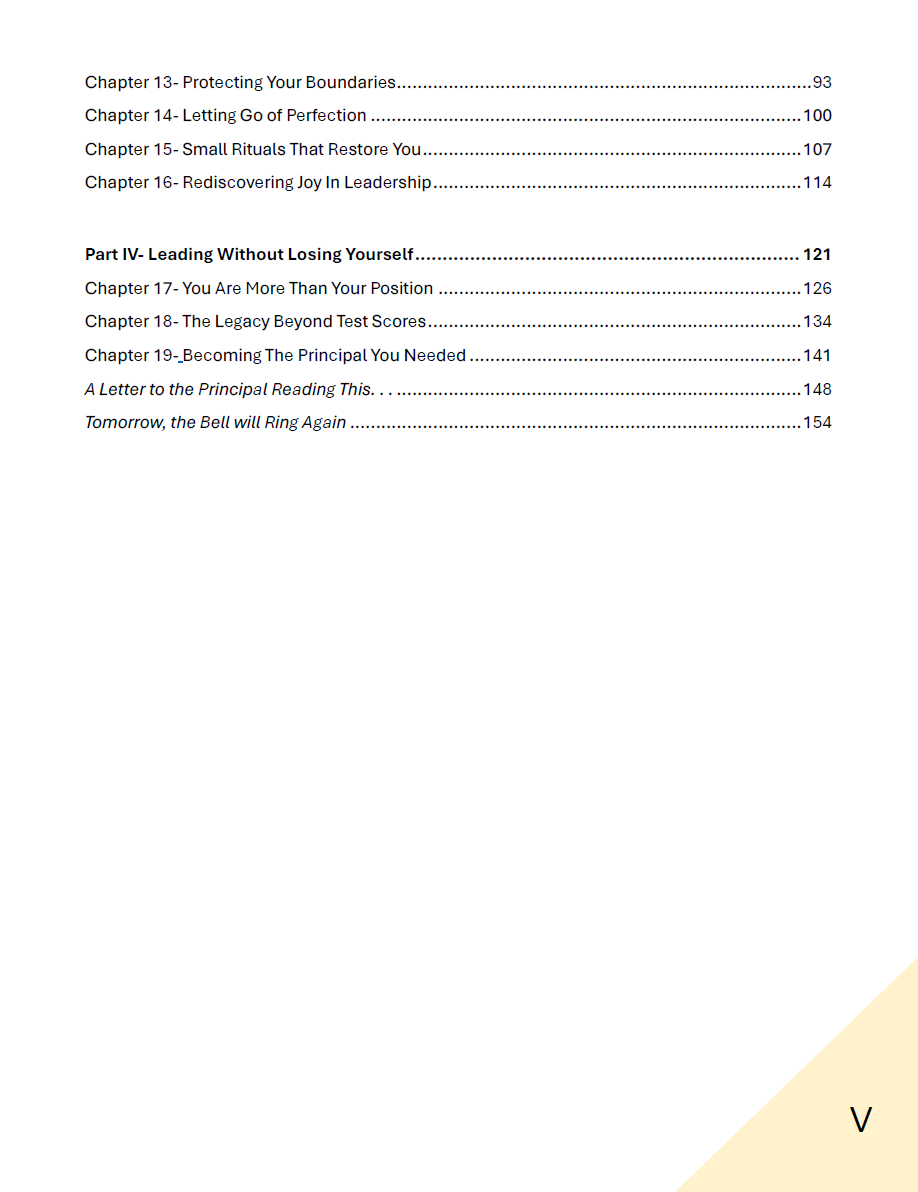
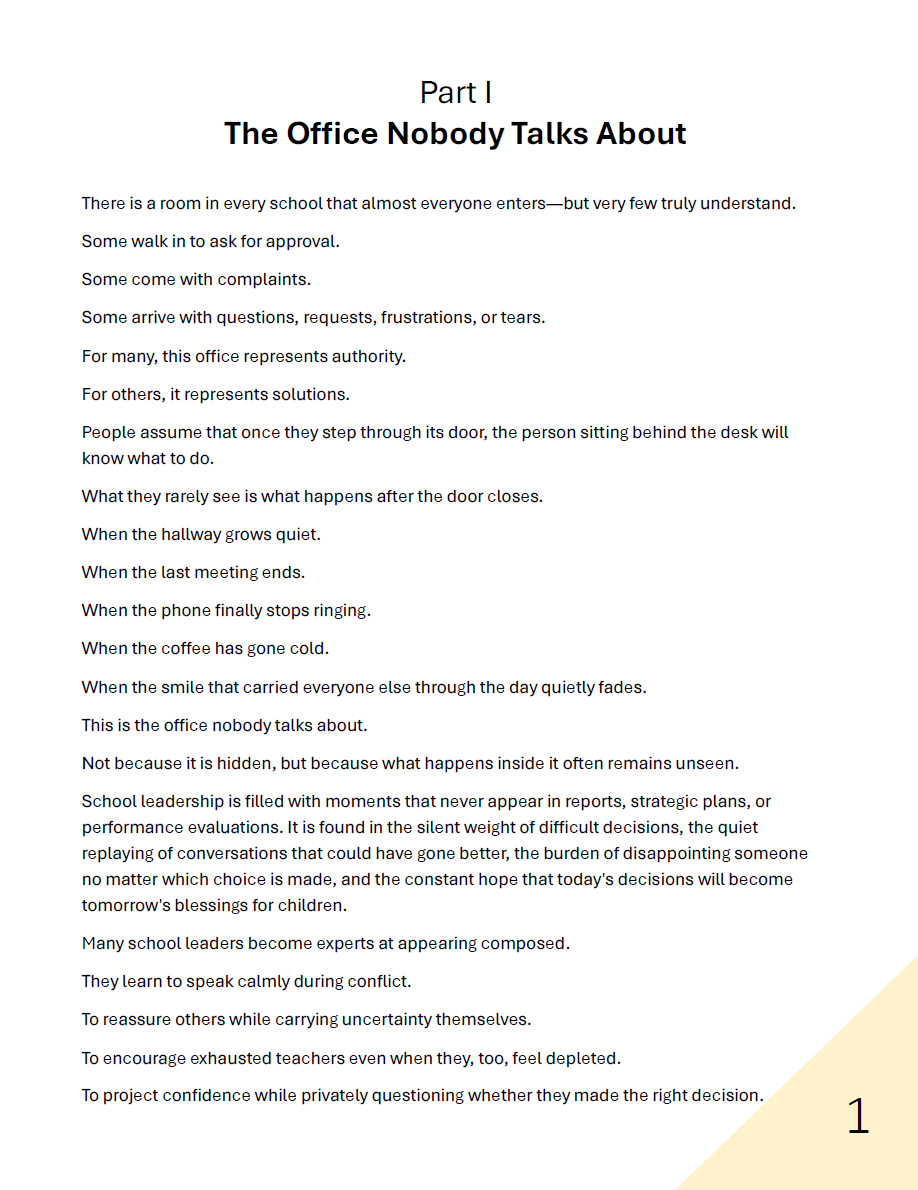
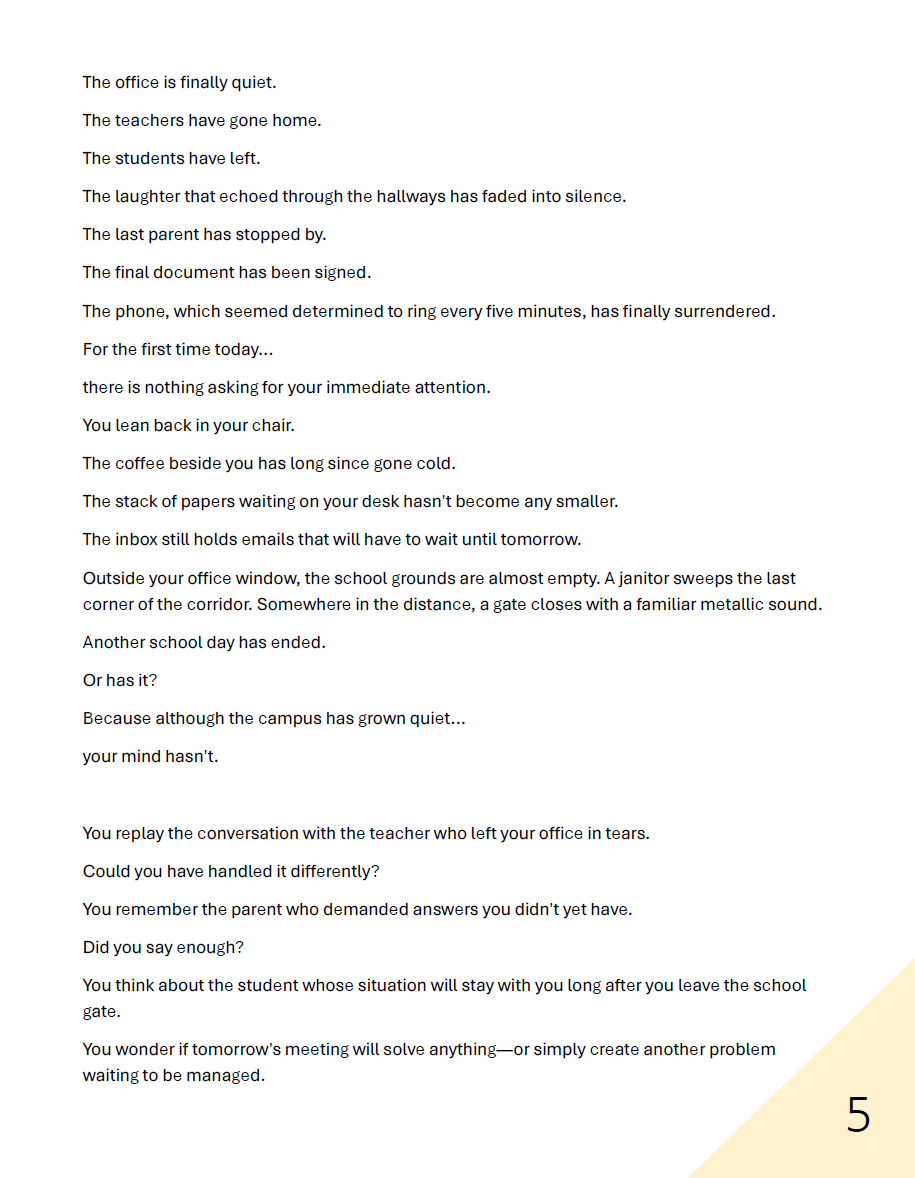
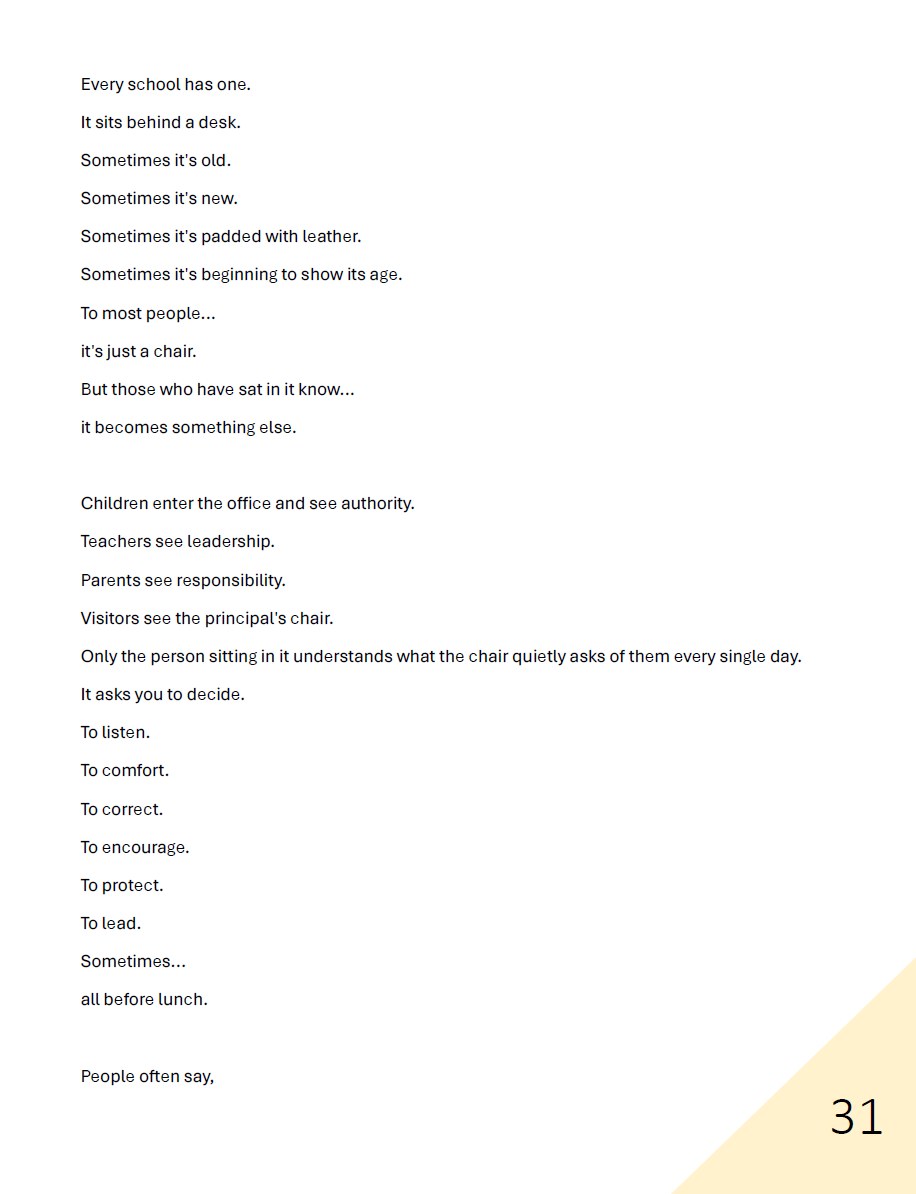
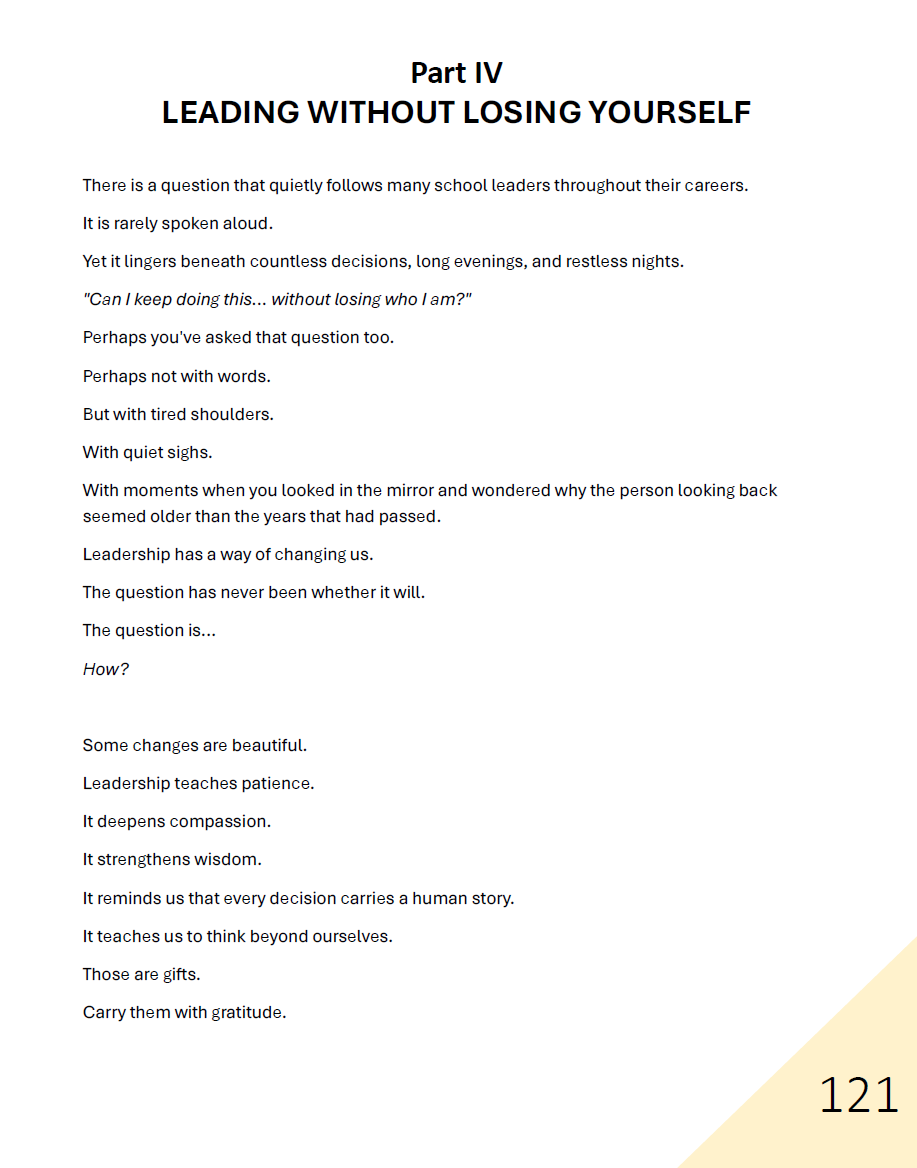
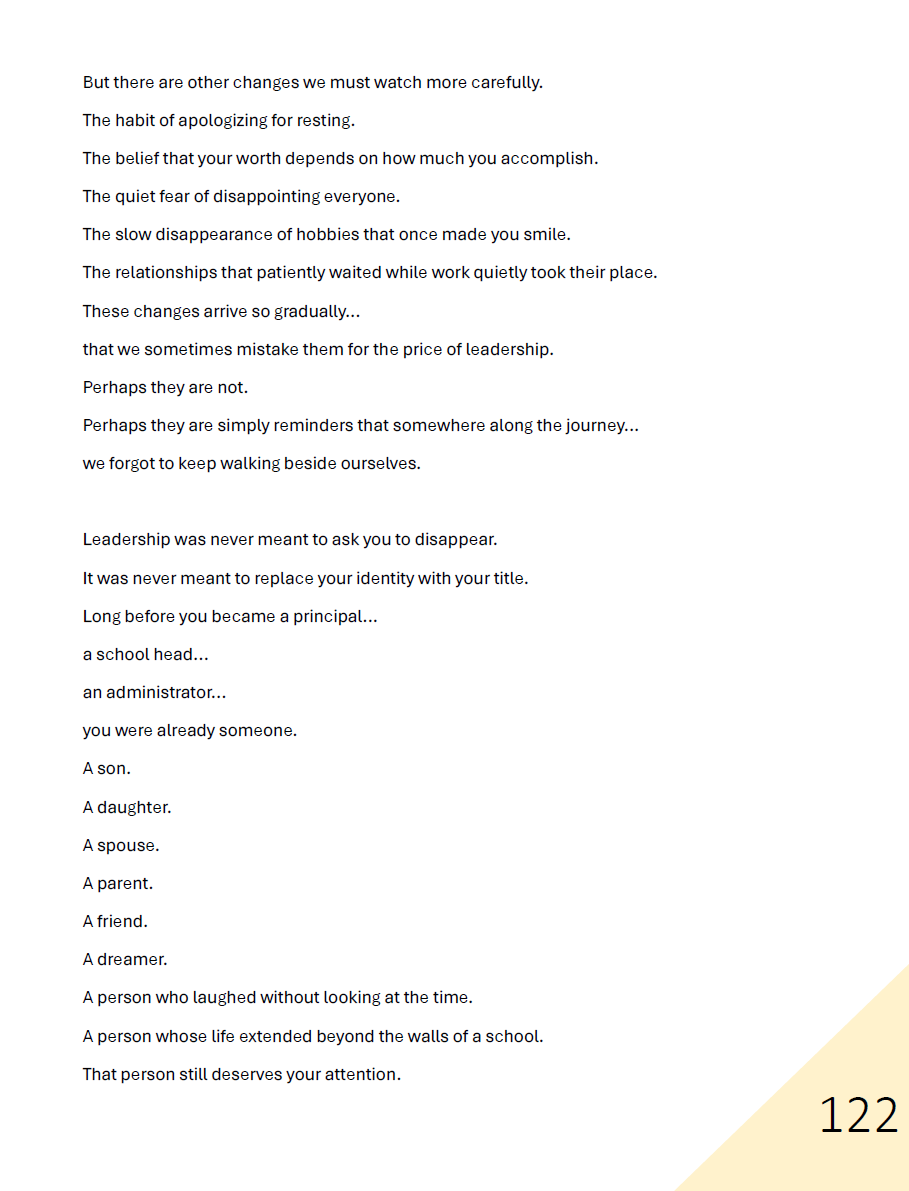
[PRODUCT PREVIEW — Actual interior reflection/excerpt page]
This is where the book goes deeper than “you are not alone.”
Knowing that other principals experience these things can be comforting.
But recognition by itself isn’t the whole point.
The deeper work is beginning to notice what you have been carrying and why.
A relationship that changed because your role changed.
A decision you’re still replaying even though there is nothing left to decide.
Someone else’s disappointment that you’ve quietly taken responsibility for fixing.
A confidential situation you’ve allowed to occupy your mind long after you’ve done everything professionally required of you.
The expectation that because you are the leader, you should somehow be emotionally available to everyone all the time.
Or the gradual disappearance of parts of your life that have nothing to do with being principal.
The book creates space to look at those experiences separately instead of allowing them to accumulate into one unnamed feeling:
I’m tired.
Because sometimes understanding the weight begins with realizing that not everything in the pile weighs the same.
Some things need your action.
Some need your attention.
Some need acceptance.
Some need a boundary.
Some need time.
And some may simply need permission to stop following you home.
The goal isn’t to care less.
It’s to understand more clearly what caring requires—and what it doesn’t.
This is for the principal who is still functioning.
Not only the leader at breaking point.
Not only someone preparing to resign.
Not only someone who has stopped loving the work.
It is for the principal who may still genuinely care about the job.
Who may still believe in the school.
Who may still have good days.
Who may still want to lead.
And who has nevertheless discovered that leadership can cost something emotionally that nobody mentioned before the appointment.
It’s for the school head who sometimes sits in the car for a few minutes before driving home.
The leader who has friends but still doesn’t know who to tell certain things to.
The principal who has become very good at saying:
“It’s fine.”
And the person behind the position who occasionally wishes someone would ask a different question:
“But how are you doing with all of this?”
You may not need another solution.
You may need somewhere that understands the problem.
There is an enormous amount of advice telling principals how to improve schools.
Improve instruction.
Improve culture.
Improve communication.
Improve systems.
Improve outcomes.
Become more effective.
Become more resilient.
Become better.
Useful advice.
But sometimes another instruction to improve yourself is the last thing you need after spending all day trying to improve everything else.
The Lonely Office isn’t standing outside your office with another checklist.
It’s sitting beside you for a while.
Looking at the parts of leadership that don’t fit neatly inside a performance indicator.
The relationships that changed.
The things that followed you home.
The pressure of always being the one expected to respond.
The distance between the public role and the private person.
But the book doesn’t simply sit with those experiences.
It helps you look at them more carefully.
To notice what belongs to responsibility.
What belongs to expectation.
What belongs to someone else’s reaction.
What has become attached to your identity.
And where there may still be room between:
the principal everyone needs
and
the person doing the job.
Because underneath all of this is a question larger than loneliness:
How do I continue leading without disappearing inside the position?
The goal isn’t to make the loneliness disappear.
A book cannot promise that.
Leadership will still require discretion.
Some decisions will still belong to you.
Some information will remain confidential.
Some days will still end with more on your mind than you would like.
But perhaps the experience can begin to feel different when you understand it.
When you recognize which parts belong to leadership rather than treating every difficult feeling as evidence that you’re doing something wrong.
When you become more deliberate about where the job ends and you begin.
When you stop expecting yourself to be emotionally available to everyone at all times.
When you allow yourself to acknowledge:
This job can be meaningful and still be heavy.
I can be grateful for the position and still find parts of it difficult.
I can care deeply about my school without carrying the entire school inside me.
Those truths can exist together.
And that is a more realistic promise than telling you that a book will somehow make difficult leadership stop feeling difficult.
You are allowed to be more than the person behind the office door.
Before the title, there was a person.
Someone with friendships that had nothing to do with school.
Interests that didn’t need to improve student outcomes.
Evenings that weren’t meant for replaying conversations.
A personality larger than a position.
That person didn’t disappear when you became principal.
But leadership can become so consuming that the boundary becomes difficult to see.
The school has needs.
So do you.
The school has problems.
Not all of them belong in your living room.
People need the principal.
But the person doing the job needs somewhere to exist too.

Perhaps you don’t need this book because something is wrong.
Maybe nothing is.
Maybe you’re doing remarkably well.
Maybe you still love parts of being a principal.
Maybe you have no intention of leaving.
Maybe you simply encountered a part of leadership nobody talked about enough.
And perhaps that’s reason enough to understand it.
Because you don’t have to wait until the job becomes unbearable before becoming curious about what it is asking from you emotionally.
You don’t have to reach breaking point before noticing that a relationship changed.
Before questioning why certain decisions follow you home.
Before recognizing that being responsible for something isn’t the same as being required to carry it forever.
Before remembering that your life is allowed to contain parts that do not belong to the school.
The office can be full all day.
And still become very quiet when the door finally closes.
If you’ve ever sat inside that quiet and wondered why a job surrounded by people can sometimes feel so strangely solitary—
this book was written for that part of the experience.
Some books give you information.
Others give you language for something you have been living without knowing how to name.
The Lonely Office was written to be the second kind.
But language is not the end of its value.
Language gives you something to notice.
Something to examine.
Something to separate from the vague feeling that perhaps you simply aren’t handling leadership well enough.
The decision you replay.
The conversation you couldn’t have.
The evening when the school came home with you.
The friendship that changed.
The moments when everyone needed something.
The responsibility that slowly became emotional ownership.
The role that became larger than the person inside it.
These experiences become easier to examine when they stop being one unnamed weight.
And sometimes understanding what you’re carrying is the beginning of deciding what still deserves to be carried tomorrow.
You don’t have to wait until the job becomes too heavy to talk about what it weighs.
You spend enough of your day being there for everyone else.
Perhaps it’s time to read something that was written for you.
Not another demand.
Not another leadership standard.
Not another reminder to become more resilient.
A book that begins with:
I understand why this feels different now.
And then stays with the question long enough to ask:
What belongs to the position—and what are you allowed to put down?
The Lonely Office
The Hidden Emotional Cost of School Leadership
For school leaders who have discovered that being surrounded by people and feeling understood are not always the same thing.
Digital Edition · PDF + EPUB

Contact Us
You don’t need another person telling you to lead harder. Sometimes you need something that understands what the job actually feels like.