
Hello to everyone at The Good Principal.
A colleague sent me a link to one of your confessions last week. I ended up reading a few more that evening and thought, well, I could probably write one of these myself.
So here’s mine.
I’ve worked in education for 19 years, the last seven in school leadership. I’d prefer to stay anonymous, so Karen will do.
I still make a to-do list every single morning.
I know. After seven years as a principal, you’d think I’d have learned by now.
But I like having a plan. I like knowing what needs to get done, what can wait, and what absolutely cannot be left until tomorrow.
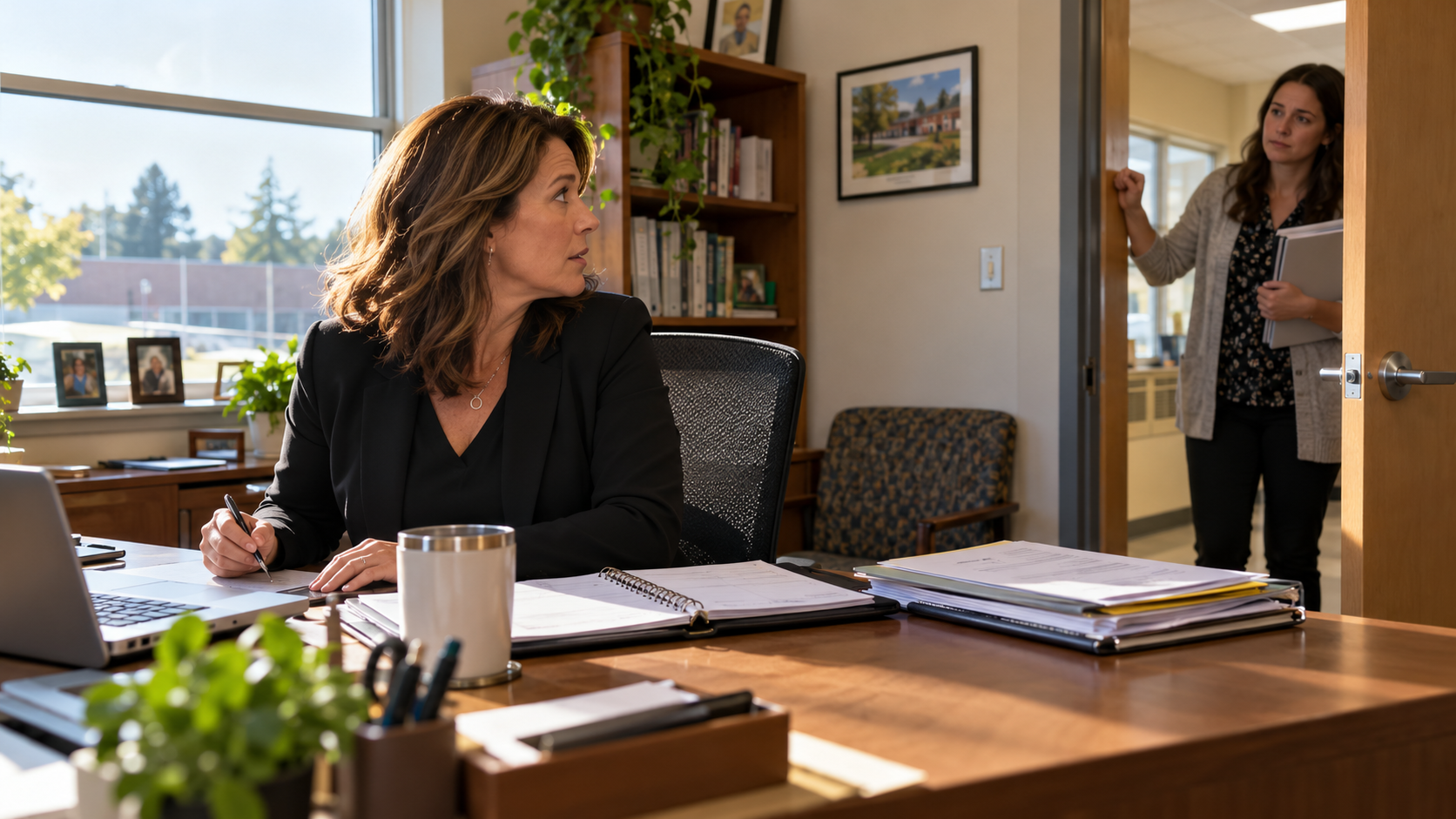
Last Tuesday, I came into my office feeling unusually organized.
Coffee on the desk. Laptop open. My list right beside me.
I even remember thinking, maybe today I’ll actually finish everything.
Then someone knocked on my door.
Every morning, before things get noisy, I write down the few things I absolutely need to finish that day.
Not ten things.
Not some perfect productivity system.
Usually three.
That feels realistic.
At least it feels realistic at 7:30.
Last week, I had one of those mornings that reminded me why my lists keep turning into carryover work.
I had a report.
A set of documents to review.
And one phone call I had already postponed for two days.
Three things.
That was it.
I even arrived early because I thought:
Finally.
I’m going to get ahead.
Then someone knocked.
7:41.
That was the end of the plan.
Not immediately, of course.
At first I still believed in it.
The teacher at the door only needed to ask about a schedule.
Fine.
Five minutes.
Maybe less.
Then while we were talking, she mentioned another issue.
Then another teacher walked past and said:
“Ma’am, when you’re free, can I ask you something?”
Sure.
Later.
Then the phone rang.
Parent.
Then another knock.
Then the office staff came in holding a paper that needed my signature.
Then the teacher from the hallway came back because apparently “later” means now if they see you sitting down again.
By 8:20, my list was still right there.
Untouched.
I looked at it and actually thought:
Okay.
Reset.
Start now.
Opened the report.
Typed one line.
Knock.
I’m not exaggerating.
One line.
I remember because I looked at the screen after the person left and thought:
Wow.
Excellent progress.
This next one was about a student.
Not something I could brush off.
So I listened.
Then I needed to call someone.
Then I needed to check something.
Then the student came back.
Then the teacher came back.
Then someone asked about an activity.
At 9:05, I had six things open on my laptop and zero things finished.
That’s a talent.
And the stupid part is I was busy.
Like actually busy.
I wasn’t scrolling.
I wasn’t wasting time.
I wasn’t sitting around doing nothing.
I was doing things nonstop.
Just not the things I planned.
That’s the part that gets me sometimes.
You can work the whole morning and still feel behind.
You can answer people, sign things, solve little issues, talk to parents, deal with students, respond to the district, and somehow your actual to-do list just sits there judging you.
Mine was beside my keyboard.
Three boxes.
Still empty.
At some point I turned the paper over.
I’m serious.
I didn’t want to look at it anymore.
Like if I couldn’t see it, maybe I wasn’t failing at it.
Very mature.
Around 10, someone said:
“Ma’am, you look busy.”
I almost laughed.
Busy is such a useless word.
Busy doing what?
I had no idea.
That was the problem.
There were so many small things that the morning had no shape anymore.
Just interruptions.
One after another.
Some important.
Some not really.
All real.
And I know people love saying:
“You have to protect your time.”
Okay.
Sure.
But sometimes the person at the door is holding a student concern.
Sometimes it’s a teacher who has clearly been waiting.
Sometimes it’s a parent who came all the way to school.
Sometimes the district is asking for something now.
Which one exactly do you ignore for the sake of your beautiful time-blocked schedule?
That’s the part those productivity tips never explain.
I finally got back to the report at 11:18.
I know because I checked the time and said something I probably shouldn’t repeat.
I had less than an hour before another meeting.
So I went into full panic mode.
Typed fast.
Checked numbers.
Opened three emails.
Couldn’t find one attachment.
Messaged someone.
Waited.
They replied.
Wrong file.
Messaged again.
While I was waiting, someone knocked.
I just stared at the door.
Didn’t say anything for maybe two seconds.
Then…
“Come in.”
Of course.
It was a quick signature.
An actual quick one.
Miracle.
I finished the report at 11:56.
Four minutes before the meeting.
I didn’t review it properly.
Sent it anyway.
Then I grabbed my notebook and walked into the meeting pretending that had all gone exactly as planned.
It had not.
After lunch, I remembered the second thing on my list.
The documents.
Still untouched.
The call?
Forgot completely.
Remembered it in the car on the way home.
That felt about right.
The next morning I found the same list on my desk.
Three items.
One crossed out.
Two carried over.
I added them to a new list.
Which honestly is probably how half my week happens.
Yesterday’s unfinished work becoming today’s plan.
Today’s interruptions becoming tomorrow’s unfinished work.
And somehow we keep acting surprised.
I still make lists, by the way.
Every morning.
I like them.
They make me feel like I have control for at least five minutes.
Sometimes ten.
Depends when the first knock comes.
That is probably why I’m sending this.
I don’t actually want to stop planning.
I just want to stop feeling like I failed every time the school day decides it has a different plan.
So I’d really like to know how other principals think about this.
Do you leave blank space on purpose?
Do you plan less?
Do you just accept that some of the day is always going to belong to things you cannot see coming?
Because I’m starting to think my problem is not that I don’t know how to plan.
Maybe I keep planning for a version of the job that does not actually exist.
Thank you for giving us somewhere to admit the ordinary mess of the day too.
Sometimes that mess is the job.
— Karen
FROM THE GOOD PRINCIPAL’S OFFICE
Karen, I think the most important sentence in your confession is this:
“I don’t want to stop planning. I just want to stop feeling like I failed every time the school day decides it has a different plan.”
That is the real issue.
Because your story does not sound like poor planning.
It sounds like a job with a high level of unpredictability.
You came in with three reasonable priorities.
Not fifteen.
Not an impossible list.
Three.
And by 7:41, the school had already started adding its own work.
That matters.
Because school leaders often judge themselves against a plan that was built before the day revealed what it was going to require.
At 7:30, you knew about the report.
The documents.
The phone call.
By 9:00, you also knew about the student issue, the parent call, the schedule question, the signature, the activity, and whatever else arrived through the door.
Those were not distractions in the ordinary sense.
They were also part of the work.
That does not mean every interruption deserves immediate attention.
But it does mean your day is partly made of things you cannot schedule the night before.
That changes how planning should probably work.
A traditional to-do list assumes the work is already known.
School leadership does not always give you that luxury.
Some of tomorrow’s most important work does not exist yet.
That parent has not called.
That student problem has not happened.
That staff member has not walked in.
The district has not sent the urgent email.
So if your plan allocates almost all of your available time before those things arrive, the day can only succeed if nothing unexpected happens.
And in a school, that is a very fragile plan.
I would not stop making your three-item list.
Actually, I like that you keep it short.
But perhaps those three items need different labels.
For example:
Must move today.
Important if the day allows.
Can carry without guilt.
That last category matters.
Because right now anything not completed seems to become evidence that you were behind.
Maybe some carryover needs to become expected instead of interpreted as failure.
Another option is to protect one priority instead of three.
Ask yourself:
If the school takes most of my day, what is the one planned task that genuinely cannot leave with me unfinished?
Then protect a realistic block for that one thing.
Not because the other work does not matter.
Because if everything is a priority, the person standing nearest to you usually wins.
You can also build interruption space into the day on purpose.
That may sound strange.
Why schedule time for things you do not know about?
Because you do know one thing:
they are coming.
Maybe you do not know who.
You do not know what.
But you know the school will generate something.
So instead of planning six hours of work into six hours of available time, perhaps you plan four.
The remaining space is not wasted.
It is capacity.
That is a very different way of looking at it.
And there is another distinction that can help:
interruption is not always the same as priority.
A knock is immediate because you hear it now.
That does not automatically make the issue behind it the most important thing in your day.
Sometimes the right answer is:
“Come in.”
Sometimes:
“Is this urgent?”
Sometimes:
“I can talk at 10:30.”
Sometimes:
“Leave that with me.”
Sometimes:
“Can this wait until tomorrow?”
That small triage matters.
Because without it, your schedule is not really being managed by priorities.
It is being managed by arrival order.
Whoever walks in next gets the next piece of you.
That is not always wrong.
A student concern may absolutely deserve to replace the report.
A safety issue definitely does.
But a routine signature probably does not need to destroy the only twenty-minute block you have protected for something important.
The key is not becoming rigid.
It is becoming intentional.
I would also challenge the way you described yourself at 9:05.
Six things open.
Zero things finished.
That feels chaotic.
But it does not mean nothing was accomplished.
You had already responded to real school needs.
The difficulty is that reactive work rarely gives you the satisfaction of closure.
A report ends with:
sent.
A document ends with:
reviewed.
A call ends with:
done.
But a student concern may lead to a call.
The call may lead to follow-up.
The follow-up may lead to another conversation.
The work keeps producing more work.
That is why principals can be fully occupied and still feel like nothing has been completed.
You may need a second way of measuring the day.
Not only:
What did I finish?
Also:
What did I keep moving?
What did I respond to before it became worse?
What did I clarify?
What did I prevent from becoming tomorrow’s bigger problem?
What did I handle that did not exist on my list when I arrived?
That is not lowering the standard.
It is measuring the actual job.
And yes, there will still be days when the planned work has to happen late.
Some deadlines are deadlines.
But if your “real work” only begins after the building empties every day, then something probably needs adjustment.
That may mean stronger boundaries.
It may mean delegating more.
It may mean creating clearer decision rights so routine questions stop travelling upward.
It may mean protecting a short closed-door block.
Or it may simply mean planning less tightly.
Probably some combination.
But I would be careful with generic advice like:
“Just protect your time.”
You were right to question that.
There is no perfectly protected schedule in a school.
The work is human.
People will interrupt.
Some interruptions will matter more than whatever is on your list.
That is reality.
The goal is not protecting the plan from the school.
The goal is creating a plan that already understands what kind of workplace it is entering.
And that is exactly why this confession fits something we keep coming back to in school leadership:
the plan is made before the people arrive.
Then the people arrive.
And everything changes.
This is one of those moments where I can genuinely say:
there is a book for that.
Managing Schools for the Terrified was written for the version of the principalship that begins after the neat plan is finished.
The teacher at the door.
The student concern that cannot wait.
The parent who calls.
The document you thought you would finish in twenty minutes.
The district request that suddenly changes the order of everything.
The problem that was not yours at 7:30 and somehow belongs to you by 7:41.
It is not another productivity book.
It is not there to tell you that all of this would disappear if you woke up earlier, used a better planner, or color-coded your calendar.
You already made the list.
That was not the problem.
The problem was that the school made one too.
Managing Schools for the Terrified is a practical survival guide for the things that happen after the day stops cooperating.
The unfinished work.
The interruptions.
The people.
The decisions.
The parts of the job that do not wait politely for an available time slot.
So if your morning plan regularly survives until approximately the first knock…
you may want to see what is inside.
Not because you need another system.
Maybe you need something written for the version of school leadership where the system gets interrupted because interruption is part of the system.
And maybe the goal is not finally having the perfect day where everything goes according to plan.
Maybe it is learning how to lead well when it does not.
Share Your Thoughts