
Hi, The Good Principal!
I’ve been reading some of the confessions here for a while now, and honestly, some of them are so familiar it’s almost funny. I never thought I’d actually send one myself, but here I am.
Please keep me anonymous if you decide to share this.
I’m a primary school principal, been in education for over 20 years and in school leadership for seven.
I had one of those mornings recently that I think only another school principal would understand.
I’m usually at school early. I make my list, check my emails, figure out what needs to get done first. You know, the usual routine. I always convince myself that if I get there before everyone else, maybe I’ll have a little bit of quiet time to finish something.
Well, that morning I arrived early again.
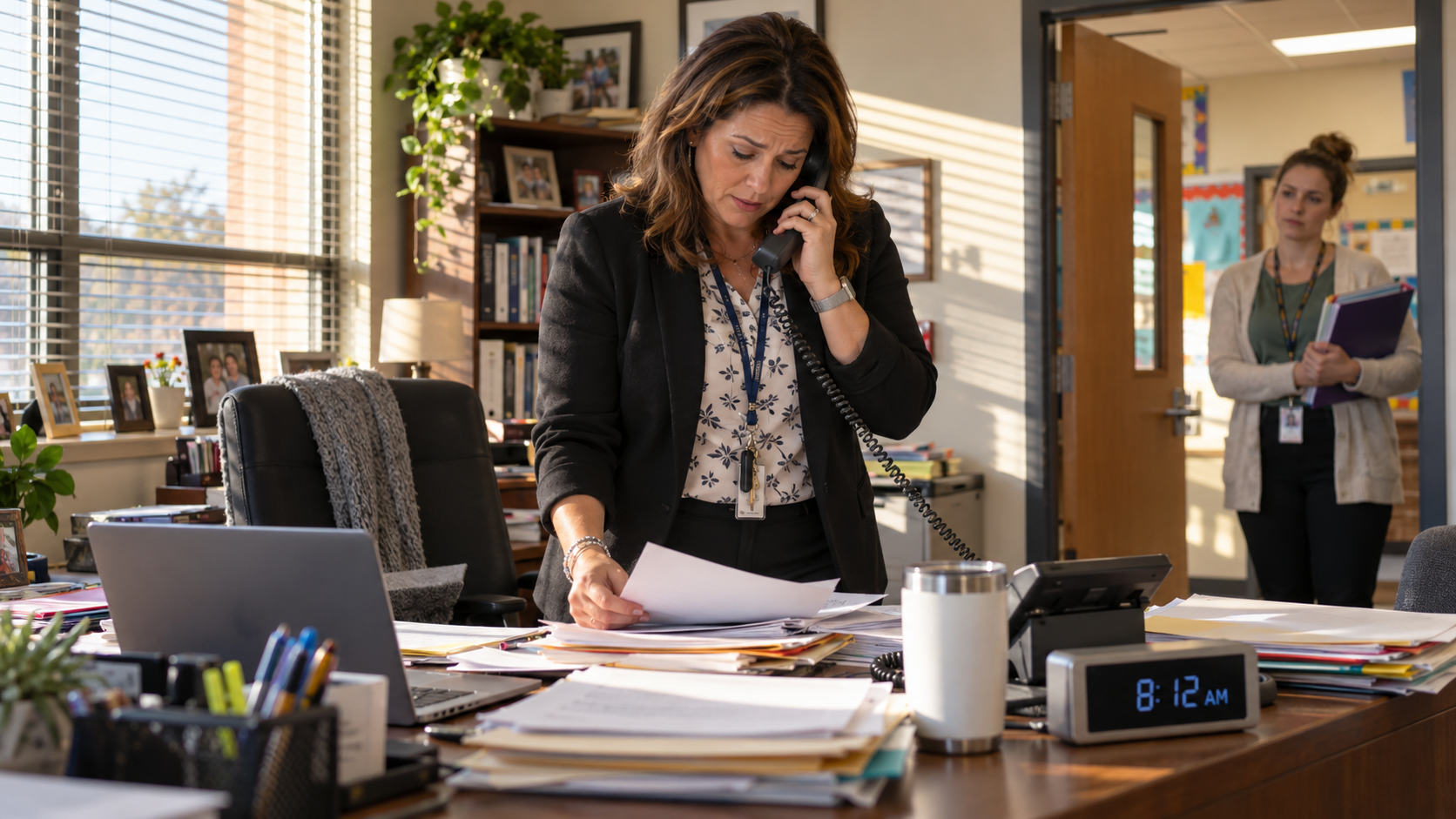
And by 8:12, my entire plan was already gone.
I should know better by now.
A few days ago I arrived around 7:30 with exactly three things I wanted to finish before the morning got busy.
Nothing ambitious.
One report.
One email I had been putting off.
One document I needed to review.
That was the plan.
At some point later that morning I looked at the clock because I already felt like half the day had happened.
It was 8:12.
That was the problem.
It was only 8:12.
And somehow I already had a parent waiting, two teachers asking me different things, one message from the district marked urgent, and a student sitting outside my office because apparently something had happened before the school day had even properly started.
I hadn’t even finished my coffee.
Actually, I don’t think I took more than two sips.
It was sitting beside my laptop getting cold while one of the teachers was explaining a problem with the schedule.
“I just want to clarify, Ma’am…”
Of course.
Clarify.
That word can mean anything.
Sometimes it means thirty seconds.
Sometimes it means you’re about to lose twenty minutes of your life.
This one was somewhere in the middle.
While she was talking, my phone started vibrating.
I glanced at the screen.
District office.
I ignored it.
Not intentionally.
Well…
maybe intentionally for about ten seconds.
The teacher was still talking and I was trying to listen, but I was also watching the phone vibrate on the desk thinking:
What now?
Then someone knocked on the open door.
Didn’t even wait.
“Ma’am, the parent is asking if you’re available.”
I looked at the teacher in front of me.
Looked at the phone.
Looked at the person standing at the door.
Then at the clock.
8:12.
I actually laughed.
Not because anything was funny.
More like…
seriously?
We haven’t even started.
The school day had barely begun and somehow I was already behind on a day that technically hadn’t happened yet.
I told the parent I’d be with her in ten minutes.
Told the teacher I’d check the schedule.
Called the district back.
Big mistake.
“Good morning, Ma’am. We just need…”
That sentence.
“We just need…”
Never trust it.
They needed a report I thought was due Friday.
Apparently it was due today.
Or maybe it had always been due today and I wrote Friday in my notes.
I honestly don’t know.
Either way, now I needed to find numbers I didn’t have yet.
So I opened the report.
Then the parent came in.
The report stayed open.
She was upset about something that had happened the day before.
Not screaming.
Nothing dramatic.
Just upset enough that this was not going to be a quick conversation.
So I listened.
And while I was listening, I could see the student still sitting outside.
Waiting.
Then another teacher walked past and pointed at the papers in her hand like:
Later?
I nodded.
Yes.
Later.
Everything was later.
My report was later.
My coffee was later.
The student was later.
The teacher with the papers was later.
Whatever I thought I was going to do that morning was definitely later.
The parent left around 8:40.
I think.
I stopped checking the clock after a while because it was making me angry.
The student came in.
Different problem.
Then the student left.
Then the teacher with the papers came back.
Then another teacher asked if I had already approved something.
I hadn’t.
I didn’t even remember seeing it.
She said:
“I sent it yesterday, Ma’am.”
That sentence made me immediately check my phone.
She did.
6:48 PM.
I had seen it too.
I just forgot.
So now I’m apologizing.
“Sorry, yes, I saw this. Let me check.”
Another thing.
Another tab open in my brain.
At around 9:30 I finally remembered the report.
Still open on the laptop.
Blank except for the title.
My coffee was still beside it.
Cold.
I drank it anyway.
Disgusting.
But I needed it.
Someone came in again.
“Ma’am, do you have a minute?”
I remember looking at the clock and thinking:
I have nothing BUT minutes apparently.
Everybody keeps taking them.
Didn’t say that.
I said:
“Sure.”
By 10:00 I had been at school for more than two hours and I couldn’t point to one thing I had actually finished.
I had answered.
Listened.
Signed.
Called.
Checked.
Promised.
Followed up.
Clarified.
But finished?
Nothing.
That’s the weirdest part of this job sometimes.
You can be busy the entire morning and still look at your desk and feel like you did absolutely nothing.
There were papers in exactly the same place.
Emails still unread.
The report still unfinished.
Coffee cup still there.
And I was already tired.
Then someone asked me later:
“Busy morning?”
I said:
“A little.”
A little.
Sure.
By lunch, I finally sent the district report.
I think it was 12:36.
The first thing I had planned to work on that morning?
Never touched it.
Not once.
It was still sitting in my notebook with a little box beside it waiting to be checked.
I actually laughed when I saw it.
Because at 7:30 that morning, I really thought I had a plan.
Cute.
There are days when I walk into school with a list.
Nice little list.
Organized.
Priority one.
Priority two.
Priority three.
Then the building wakes up.
And your list becomes this little piece of paper sitting under everybody else’s emergencies.
Sometimes they’re not even emergencies.
That’s what makes it funny.
They’re just things.
Normal school things.
A parent.
A schedule.
A report.
A student.
A teacher.
A phone call.
A document.
Nothing dramatic.
But stack enough normal things on top of each other and suddenly you’re standing in your office at 10:00 wondering how you’re already behind.
That morning, I remember thinking maybe the day would calm down after lunch.
It didn’t.
Of course it didn’t.
But honestly, by then I had stopped expecting it to.
That might be the real survival skill nobody mentions.
Not time management.
Not prioritizing.
Lowering your expectations for what “today” was supposed to look like.
Because sometimes the plan dies at 8:12.
And you’re still there at 5:00 trying to figure out what happened.
That is actually why I decided to send this.
I know there are principals dealing with much bigger things than a cold coffee and an unfinished list.
But I also think mornings like this are what most of the job actually looks like.
Nothing dramatic enough to complain about.
Just hundreds of small things arriving before you have finished the one before it.
I’d really like to know how other school leaders handle that without going home feeling like they failed to accomplish anything.
Do you still make detailed plans?
Do you leave space for interruptions?
Do you just accept that some days the list is basically fiction?
Because I’m starting to think I may need a different way of deciding whether I had a productive day.
Thank you for giving us somewhere to talk about the ordinary chaos too.
Sometimes that is the part of leadership I find hardest to explain to people who have never sat in this office.
— Laura
FROM THE GOOD PRINCIPAL’S OFFICE
Laura, nothing extraordinary happened in your story.
And I think that is exactly why it matters.
There was no major emergency.
No evacuation.
No screaming match.
No crisis meeting.
Nothing happened that would make someone outside the school say:
“That must have been an incredibly difficult morning.”
It was just…
a parent.
A student.
A teacher.
A schedule.
A report.
A phone call from the district.
A document.
Another question.
Then another.
Individually, none of those things sounds impossible.
Put them all between 7:30 and 10:00 in the morning and suddenly the report you thought you would finish before everyone arrived is still sitting there blank.
And then something strange happens.
You start calling yourself unproductive.
That is the part I would challenge.
Because there is a difference between:
not completing your planned work
and
not doing useful work.
Your notebook measured one version of the morning.
The school created another.
Your list said:
finish the report.
The school said:
there is a parent waiting.
Your list said:
answer the email.
The school said:
there is a student outside your office.
Your list said:
review the document.
The district called.
Again.
That does not mean planning is useless.
Planning still matters.
But perhaps the plan has to acknowledge something school leaders already know:
a large part of your work does not exist yet when you make the list.
That is unusual.
A teacher can often see the lessons she needs to teach that day.
An administrator working on a project can usually see the project.
But school leaders work in an environment where a significant portion of the day arrives unannounced.
It walks through the door.
Calls the office.
Appears in the hallway.
Sends a message marked urgent.
And the difficult part is that the unplanned work often comes attached to a person.
That changes everything.
A report can wait ten minutes.
A parent already sitting outside feels harder to postpone.
An email can sit unread.
A student waiting outside your office feels different.
A spreadsheet does not look disappointed when you say:
“Later.”
People do.
That is why simply telling yourself to “stick to the schedule” does not always work.
The real skill may be learning how to distinguish between three kinds of work:
What genuinely must happen now.
What matters but can happen later.
What feels urgent mainly because another person is standing in front of you.
Those categories are not always obvious.
But they matter.
Because if everything that reaches you becomes immediate, the day will always belong to whoever arrives next.
And your important work will only happen after everyone else has gone home.
You mentioned something else that I think a lot of principals will recognize:
By 10:00, you had finished almost nothing.
But look at what you had actually done.
You had listened to a parent.
Handled a student concern.
Responded to the district.
Clarified a schedule.
Reviewed a request.
Answered questions.
Made commitments.
Moved several situations forward.
That is work.
It just does not leave the same visible evidence as completing a report.
A finished document gives you closure.
A twenty-minute conversation often does not.
You may leave the conversation with three more things to do.
That is probably part of why leadership can make people feel strangely unproductive even when they have been working continuously.
Much of the job creates movement, not completion.
That distinction might help at the end of the day.
Instead of only asking:
“What did I finish?”
try asking:
“What did I move forward?”
Who got an answer?
What situation became clearer?
What problem became smaller?
What decision was made?
What did not become a bigger problem because you dealt with it today?
That does not magically finish your report.
But it gives you a more accurate picture of where your time went.
I would also reconsider how you plan your mornings.
If you already know the school produces unpredictable work, then perhaps every minute should not be assigned before the day begins.
If your list assumes two uninterrupted hours and your actual job rarely gives you two uninterrupted hours, the plan may be setting you up to feel behind before breakfast.
Maybe you plan three levels instead.
One thing that genuinely must happen today.
Two things you would like to move forward.
Everything else is secondary if the school takes the day somewhere else.
That sounds almost too simple.
But the point is not the number three.
The point is leaving room for reality.
Because sometimes leaders build schedules for the day they wish they had rather than the day their job actually gives them.
Then they judge themselves against the imaginary day.
You also mentioned that by lunch you had lowered your expectations for what the day was supposed to look like.
I would change one word there.
Maybe you were not lowering your expectations.
Maybe you were updating them.
At 7:30, you knew one set of facts.
By 8:12, the school had given you new information.
A parent needed time.
A student needed attention.
The district had changed the priority.
Several staff members needed answers.
A reasonable leader adjusts.
That is not failure.
That is responsiveness.
The problem comes when responsiveness becomes completely reactive.
If you reach the point where you cannot protect even fifteen minutes for anything important because every interruption wins automatically, then yes, you may need stronger boundaries.
But a day being different from the plan does not automatically mean the day went badly.
Sometimes the day simply revealed its actual priorities after you arrived.
There is another practical habit that may help.
When someone comes to the door, ask yourself before automatically saying yes:
Does this need me now?
Not:
Does this matter?
Those are different questions.
It can matter and still wait until 11:30.
You can say:
“I want to look at that. Can you come back after recess?”
“Leave this with me and I’ll get back to you this afternoon.”
“I’m in the middle of something. Is this urgent?”
Those sentences keep the interruption from automatically becoming the new priority.
And they help your staff understand that being accessible does not mean every question receives an instant response.
But even with better boundaries, there will still be mornings like 8:12.
That is part of why this confession fits something we rarely say plainly about school leadership:
the work will never actually be finished.
There will always be another parent.
Another message.
Another form.
Another teacher.
Another problem.
Another thing waiting for tomorrow.
Which means survival cannot depend on reaching the magical day when everything is finally checked off.
That day is probably not coming.
And this is one of those moments where I can genuinely say:
there is a book for this.
Not because you need another planner.
And definitely not because you need someone to explain prioritizing, delegation, communication, or time management as if you have never heard those words before.
You probably have.
Managing Schools for the Terrified was written for what happens after all the sensible planning is finished and the actual school starts happening around you.
The teacher at the door.
The parent who did not make an appointment.
The student problem you did not know existed yesterday.
The thing the district suddenly needs.
The work that keeps getting pushed.
The days when leadership disappears underneath administration.
The uncomfortable realization that somehow everything eventually becomes your problem.
It is not a book about becoming perfectly organized.
It is a practical survival guide for principals dealing with the things that refuse to wait politely for an empty space on the calendar.
Because sometimes the real problem is not:
“How do I stop interruptions?”
You probably cannot.
The better question is:
“How do I lead a school where interruptions are part of the work without feeling like I failed every time the day does not follow the plan?”
That is much closer to the world Managing Schools for the Terrified was written for.
So if you have ever looked at the clock, felt completely exhausted, and discovered that it was somehow only 8:12…
you may want to see what is inside.
Not because you need someone to teach you how to be a principal.
Maybe you just need something that understands why the plan looked perfectly reasonable at 7:30…
right before the school woke up.
Share Your Thoughts