
Dear Good Principal,
I’m not even sure this counts as a confession, but I wanted to share it anyway.
I’ve been following the stories here and I noticed that most of us seem to talk about the big things. Difficult parents, staff problems, decisions that keep us awake at night.
Mine is about a lunchbox.
Yes, seriously.
I’m a primary school principal. Twenty-one years working in education, eight of those in leadership. Please don’t include my real name if this gets published. Emma is fine.
I don’t remember the last time I actually sat down and enjoyed a proper lunch at school without someone needing something.
I used to joke about it with my staff. We’d laugh and say that’s just what happens when you’re the principal.
But something happened the other afternoon that made me realize I wasn’t really finding it funny anymore.
I’ve had harder days than this.
Much harder.
I’ve dealt with angry parents, staff problems, difficult student situations, deadlines, inspections, all the usual things.
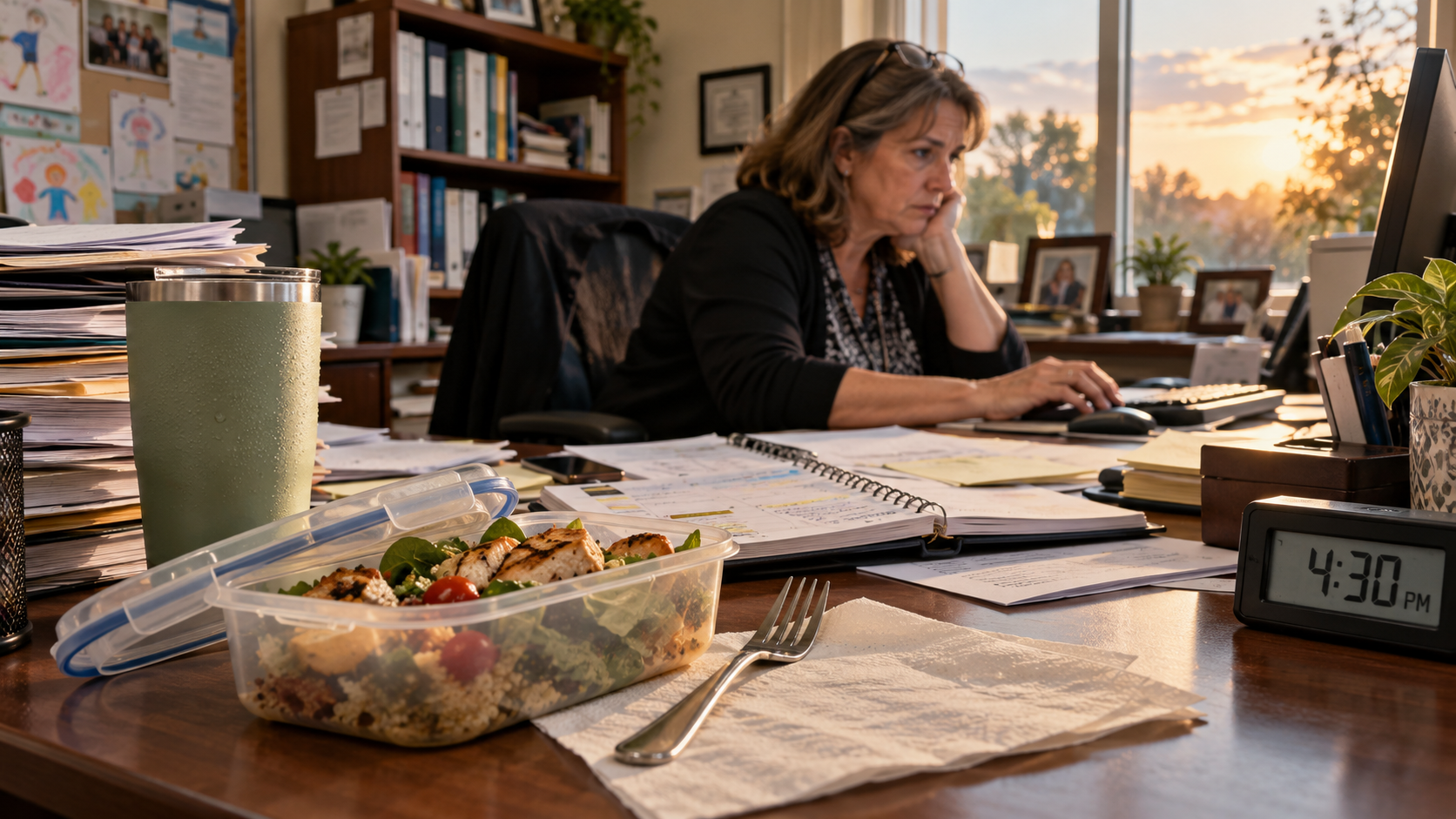
But for some reason, one ordinary day recently stuck with me because of what was still sitting on my desk at 4:30.
My lunch.
Exactly where I had left it.
At 12:10, I put my lunch on the corner of my desk.
That was the plan.
Eat.
Ten minutes, maybe fifteen if I got lucky.
I even closed one tab on my laptop like I was making space for a proper break.
Then someone knocked.
“Ma’am, sorry, can I ask something?”
Sure.
Of course.
Come in.
It was about a student, so I listened. While we were talking, another teacher appeared at the door holding papers.
She didn’t come in.
She just stood there.
Waiting.
I saw her.
She saw me see her.
So now she was officially next.
The first teacher left.
The second one came in.
Signatures.
Easy.
Except one of the papers had something missing.
So now we were checking.
Then she remembered another form.
Then another question.
Then…
“Ma’am, one more thing.”
Of course.
Lunch stayed on the desk.
Still wrapped.
I remember looking at it while she was talking.
Like it had personally betrayed me.
She finally left.
I reached for the container.
Phone rang.
Parent.
Not angry exactly.
Concerned.
And sometimes concerned takes longer because angry parents usually tell you immediately what they’re upset about.
Concerned parents start at the beginning.
Then there’s context.
Then history.
Then:
“Ma’am, I don’t know if you’re aware of this…”
I wasn’t.
Now I was.
The call ended.
12:47.
Okay.
Still fine.
Lunch.
I opened the container.
One bite.
Literally one.
Then someone from the office came in.
“Ma’am, there’s a parent waiting outside.”
I almost said:
So?
I didn’t.
Obviously.
I asked who it was.
Different parent.
No appointment.
“Okay. Give me five minutes.”
Five minutes.
Very optimistic.
I ate maybe three more bites, covered the food again, wiped my mouth, and called the parent in.
She sat down and immediately said:
“Ma’am, I’m sorry. I know this is your lunch break.”
I wanted to say:
Yes. Yes it is.
Instead I smiled.
“It’s okay.”
It was not okay.
Not really.
But what are you supposed to say?
“Actually, yes. This is my lunch and I would like to finish chewing before we discuss your child.”
Maybe I should’ve said that.
I didn’t.
The conversation took about thirty minutes.
Nothing dramatic.
Just one of those conversations you cannot rush because if you rush it, you’ll probably make things worse.
She left.
I looked at the food.
Cold.
Not warm.
Not room temperature.
Cold.
I took another bite anyway.
Then the district office called.
I actually laughed.
Not because anything was funny.
Just…
of course.
Why wouldn’t they call now?
They needed something emailed that afternoon.
I told them I would send it.
Opened the file.
Couldn’t find the attachment.
Checked another email.
Still nothing.
Messaged someone.
Waited.
While waiting, I thought, okay.
Eat.
Opened the lunch again.
Then a student was brought in.
I am not making this up.
At this point the lunch had been opened and closed so many times I honestly thought maybe I should just give up.
The student issue took a while.
Then I had to call someone.
Then another person came in.
Then I remembered the district email.
Sent that.
Then the teacher from earlier came back because apparently the form still needed something.
By around 2:30, I stopped thinking about lunch completely.
That’s the weird thing.
At first you’re hungry.
Then you get busy enough that your body just stops reminding you.
I had coffee sometime around 3.
Bad idea.
Empty stomach.
But whatever.
At least it was something.
Then at 4:30, I finally started cleaning my desk.
That’s when I saw it.
My lunch.
Still there.
Container closed.
Fork beside it.
Half eaten.
I just stared at it.
4:30.
I had packed that food in the morning thinking I was being responsible.
Look at me.
Prepared lunch.
Very organized.
Very adult.
And there it was at the end of the day looking like proof that the day won.
I wasn’t even hungry anymore.
Just annoyed.
Not at anyone specifically.
That’s important.
Nobody walked into my office thinking:
“Let’s make sure Ma’am doesn’t eat today.”
They all had reasons.
Real ones.
The teachers needed something.
The parents had concerns.
The student issue had to be handled.
The district deadline existed whether I had eaten or not.
That’s what makes days like this irritating.
There’s no villain.
Just too many normal things.
And somehow enough normal things can erase a whole day.
I took the lunch home.
Didn’t eat it.
By then I didn’t want it anymore.
That night, while washing the container, I actually thought about how ridiculous it was that I couldn’t find fifteen minutes to eat food I had already brought with me.
Fifteen minutes.
That’s all.
And before anyone says:
“Ma’am, you need to prioritize yourself”…
yes.
I know.
I know.
But lunchtime at school does not always behave like lunchtime.
Sometimes it’s just another part of the day where people can still find you.
Actually, maybe they find you faster because they know you’re in the office.
There are days I deliberately leave school just to eat somewhere else because if I stay inside, I know what happens.
“Ma’am, since you’re here…”
There it is.
Since you’re here.
That phrase has destroyed many lunches.
And the stupid thing is, I let it happen.
I keep saying:
“Okay.”
I keep saying:
“Sure.”
I keep saying:
“Come in.”
Then at 4:30 I look at a cold lunch and act surprised.
That is probably what bothers me most.
The school is not stealing my lunch.
I am handing it over.
Five minutes at a time.
I don’t want to become the principal who is impossible to reach between 12 and 1.
That does not feel realistic either.
If a student really needs me, of course I will respond.
If something urgent happens, lunch can wait.
I know that.
But I’m starting to wonder if I have accidentally made everything important enough to interrupt it.
A signature.
A question.
A parent without an appointment.
A form.
Something that could probably wait fifteen minutes.
I treat all of it like it has to happen now.
Then I complain that I never get a break.
That part is on me.
So I’m sending this partly because I want to hear what other principals actually do.
Do you close the door?
Do you leave the building?
Do you tell the office not to send anyone in unless it is urgent?
And does that actually work without making people feel like they cannot approach you?
Because I know this is only lunch.
But I also know I should probably be able to sit down and eat one meal without feeling guilty for making someone wait fifteen minutes.
Maybe tomorrow I’ll close the door.
Maybe I’ll put a note outside.
Maybe I’ll actually say:
“I’m eating. Come back in fifteen minutes.”
Sounds easy.
We’ll see.
Because tomorrow someone will probably knock at 12:10 and say:
“Ma’am, sorry, just one quick question…”
And knowing me?
I’ll probably say:
“Come in.”
Thank you for letting me admit something this ordinary.
Maybe that is why I needed to say it somewhere.
— Emma
FROM THE GOOD PRINCIPAL’S OFFICE
To Emma, I do not think this is really a confession about lunch.
The lunch is just where the pattern became visible.
Because your story shows something school leaders can do very easily without noticing:
you keep making yourself the most movable thing in the room.
The parent has already arrived.
So you move your lunch.
The teacher is already standing there.
So you move your lunch.
The district wants something that afternoon.
So you move your lunch.
The student needs attention.
So you move your lunch.
And because eating can technically happen later, it keeps losing.
That makes sense once.
Maybe twice.
The problem is when “later” becomes the normal arrangement.
Because the school will always have another reason.
There will always be a person whose concern feels more legitimate than your sandwich.
And that is why this probably cannot be solved by waiting for a quiet day.
The quiet day may not come.
The boundary has to exist inside the busy day.
And I think you identified one of the biggest problems yourself:
You are treating interruption and urgency as if they are the same thing.
They are not.
Someone being physically present does not automatically mean the matter is urgent.
A parent waiting outside may feel immediate because you know she is there.
But if the issue can wait fifteen minutes, then perhaps the answer is:
“Please let her know I’m finishing lunch and I’ll see her at 12:30.”
That may feel uncomfortable at first.
But notice what you are actually saying.
Not:
“I do not care.”
Not:
“I will not see her.”
Just:
“I will see her in fifteen minutes.”
That is a perfectly reasonable sentence.
The same applies to staff.
“Can I ask something?”
“Yes. Is it urgent?”
If not:
“Come back in fifteen minutes.”
That question alone may protect more time than you expect.
Because right now the rule seems to be:
If someone asks, I stop.
You may need a different default:
If someone asks, I first decide when I can respond.
That small pause gives you back some control.
There is another thing worth noticing.
You said the parent apologized because she knew it was your lunch break.
And you replied:
“It’s okay.”
Even though it was not.
That may seem polite.
But repeated often enough, those little “it’s okay” moments teach everyone—including you—that your break is optional.
Sometimes honesty can actually be kinder.
You do not have to make the other person feel guilty.
You could simply say:
“No problem. Give me ten minutes to finish eating and then I’m yours.”
Warm.
Clear.
No resentment.
No pretending.
That is probably better for both people than letting her in immediately and silently thinking:
Please let me finish chewing.
Because boundaries that never get spoken often come out later as irritation.
And the other person does not even know why.
I would also challenge the idea that protecting lunch makes you less approachable.
Approachable does not mean instantly available.
A leader can be easy to reach while still having small protected windows.
Actually, predictable boundaries can make access clearer.
Imagine your staff knows:
Between 12:15 and 12:35, unless something is urgent, Ma’am is eating.
That is twenty minutes.
Not an hour.
Not some luxury retreat.
Twenty minutes.
After 12:35, the door opens again.
Now nobody has to guess.
And you do not have to renegotiate the boundary every single time someone appears.
You might even coordinate with office staff.
Something simple:
“If someone arrives during lunch, please ask whether it is urgent. If it can wait, let them know I’ll see them at 12:35.”
That way, the person standing outside is not immediately transferred to you just because she exists.
The office helps protect the boundary too.
And yes, there will be exceptions.
A genuine student issue.
A safety concern.
Something that really cannot wait.
Then you stop eating.
Of course.
But exceptions only work if there is a normal rule to interrupt.
If everything is an exception, nothing is.
There is also something slightly bigger underneath this.
The pattern in your story is:
everyone else’s need receives legitimacy automatically; yours has to prove itself.
A parent concern is legitimate.
A student problem is legitimate.
A district deadline is legitimate.
But hunger?
That apparently has to wait until the building is finished with you.
That is an unfair standard to hold yourself to.
Eating lunch is not some reward for completing enough work.
It is not indulgence.
And it does not need a leadership rationale.
You are allowed to eat because you are a person who has not eaten.
That is enough.
And maybe that sounds almost embarrassingly obvious.
But school leadership can make obvious things strangely difficult.
Because there is always something productive you could be doing instead.
There is always someone you could help instead.
There is always one more thing.
Which means if you wait until nobody needs you, your needs will always come last.
I would also think about the fact that you stopped noticing hunger around 2:30.
That can feel like proof that you were “fine.”
It is not really proof of anything except that you got distracted.
The body is surprisingly good at becoming background noise when the mind is overloaded.
That does not mean the need disappeared.
It just stopped getting your attention.
And there is a leadership parallel there too.
Small needs can be ignored for a long time precisely because nothing dramatic happens when you ignore them once.
You miss lunch.
Fine.
You do it again.
Fine.
You stay late.
Fine.
You answer after hours.
Fine.
None of these individually looks serious.
That is why patterns are easier to miss than crises.
So maybe the lunch container is useful.
Not as proof that the day “won.”
As information.
It tells you:
today I allowed ordinary work to consume even the smallest protected space I had.
Then the next question is not:
“How do I make sure nobody interrupts me tomorrow?”
That probably will not happen.
The question is:
Which interruptions actually deserve to win?
A student safety issue?
Yes.
An upset parent who can wait fifteen minutes?
Maybe not.
A missing signature?
Probably not.
A district call?
Depends what they need.
That kind of triage is not selfish.
It is part of managing a school.
You already prioritize competing needs for everyone else.
You may simply need to include yourself somewhere in that system.
And I would start very small.
Do not promise yourself a perfect uninterrupted hour.
You may fail by Tuesday and then decide boundaries do not work.
Start with fifteen minutes.
Pick a realistic time.
Tell the office.
Close the door.
Eat.
If something genuinely urgent happens, deal with it.
Then go back to lunch if you can.
The goal is not perfection.
The goal is changing the assumption that your lunch is automatically the first thing to sacrifice.
And when someone knocks tomorrow at 12:10 and says:
“Ma’am, just one quick question…”
maybe this time you try:
“Absolutely. Give me fifteen minutes and come back.”
Then finish your food.
Not because the question does not matter.
Because fifteen minutes later, it will probably still matter.
And you will be there.
Share Your Thoughts