
I’m not sure how to start this, so I’ll just get straight to it.
I’m Michael, at least that’s the name I’d prefer to use here. I’ve been a secondary school principal in Queensland, Australia, for six years now. Before that, I spent most of my 20-plus years in education teaching.
I came across The Good Principal and thought maybe this was the right place to share something I haven’t really talked about with anyone.
Lately, I’ve caught myself doing something that I’m not exactly proud of. And the worst part is, I think it’s becoming a habit.
It’s not a major leadership failure. Nobody got hurt. Nobody filed a complaint. Nothing dramatic happened.
Actually, if you worked in my school, you probably wouldn’t even know this was happening.
But I know.
And I think that’s why it bothers me.
I’ve always tried to be the kind of principal people can approach. My office door is open most of the time. Staff know they can come in. Students stop by. Parents sometimes appear without appointments. I’ve always told myself that being available is part of being present.
I still believe that.
The problem is, lately there are days when I see someone walking toward my office and I find myself hoping they keep walking.
That happened one morning recently.
It was 10:47.
I know because I kept looking at the clock like somehow that would make the morning move faster.
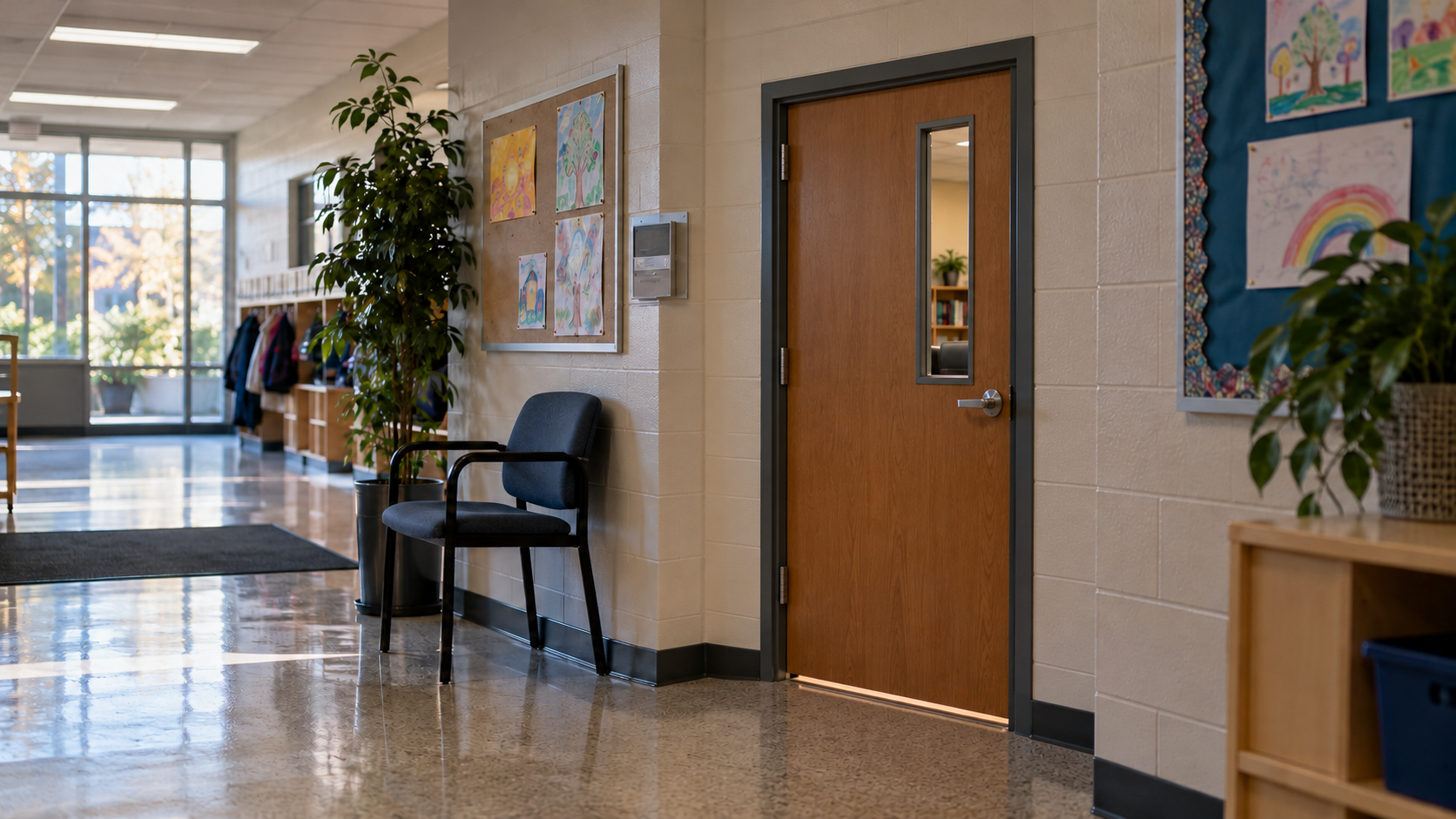
My door was open.
Big mistake.
I was trying to finish one stupid report that should’ve taken maybe twenty minutes. I had been working on it since 8:30.
By 10:47, I had written maybe three decent sentences.
Because people kept coming in.
A teacher needed a signature. Then someone asked about a schedule. Then a parent came in without an appointment. Then a student got sent to the office. Then somebody from the district called.
Then another teacher stood by the door and said, “Sir, very quick.”
It was not quick.
Of course.
At some point I stopped even pretending I was going back to the report.
I just stared at it.
Same paragraph.
Same blinking cursor.
Then I heard footsteps in the hallway.
And this is going to sound bad, but my first thought was:
Please don’t knock.
Not, “I hope everything is okay.”
Not, “I wonder who that is.”
Just…
please don’t knock.
The footsteps got closer.
I actually watched the shadow pass the doorway.
And I swear I was holding my breath like an idiot.
Keep walking.
Keep walking.
Keep walking.
They kept walking.
I felt relieved.
Like genuinely relieved.
Then maybe thirty seconds later, somebody else came.
Knock knock.
I wanted to say fuck.
I didn’t.
Obviously.
But I thought it.
Very clearly.
And that’s the part I would never say in front of my teachers.
Because technically they weren’t doing anything wrong.
They were doing exactly what people do in schools.
They need something.
They ask.
They check.
They clarify.
They bring problems because… well, where else are they supposed to bring them?
To the principal.
To me.
I know that.
Still didn’t make me want to answer the door.
“Come in.”
One of the teachers entered holding papers.
She started with, “Sorry, sir, I know you’re busy.”
I almost laughed.
Not because it was funny.
Because I wanted to say:
Then why are you here.
I did not say that.
Thank God.
I asked what she needed.
Turns out it was simple.
A request.
I checked it.
Signed it.
Maybe four minutes.
She thanked me and left.
And for some reason those four minutes pissed me off more than they should have.
Again, not because of her.
She was polite.
She even apologized for interrupting.
It was because I knew the moment she left, somebody else could come in.
There’s this weird thing about the principal’s office.
If the door is open, you’re available.
Doesn’t matter what you’re doing.
You could be writing a report due in thirty minutes. You could be answering an email from the district. You could be trying to eat lunch.
If somebody sees you sitting there, technically you’re there.
So they ask.
And sometimes I wish they wouldn’t.
That sounds awful.
I know.
But there are days I look at my office door and genuinely wish I could put a sign outside saying:
PLEASE DO NOT NEED ME FOR 30 MINUTES.
Not “Do Not Disturb.”
That sounds too formal.
Just…
please.
I am begging you.
Nothing else today.
No forms. No questions. No “Can I just ask…” No “Sir, since you’re here…” No “One last thing…”
Just let me exist in this chair without somebody attaching a problem to me.
I’ve even caught myself getting irritated at the knock itself.
Not the person.
The sound.
Knock knock.
Sometimes that sound already means work before I even know what the work is.
And I hate that I think like that because some of the best conversations I’ve had as a principal started with someone knocking.
A teacher who needed help.
A student who finally decided to talk.
A parent who calmed down after we actually sat together.
I know the door matters.
I know availability matters.
But some days I don’t want the door to matter.
I want it to just be a door.
There was one afternoon when I finally shut it.
Nothing dramatic happened.
No breakdown.
No big realization.
I just got up and closed it.
Then I sat back down.
Maybe five minutes later…
knock.
Of course.
I stared at the door.
Didn’t answer right away.
Knock again.
“Sir?”
I knew the voice.
One of the staff.
I almost said, “Can it wait?”
I should’ve probably said it.
That would’ve been normal.
Instead I answered, “Yes?”
He opened the door halfway.
“Sir, sorry, just one question.”
I remember thinking:
There is no such thing as one question in this school.
He came in.
Asked.
I answered.
Then there was another question.
Then one more thing.
By the time he left, maybe fifteen minutes had passed.
I closed the door again.
This time I locked it.
Yeah.
I locked it.
That felt ridiculous too.
It’s my office.
Why did I feel like I was hiding?
But I did.
And I stayed there for maybe twenty minutes.
Didn’t answer emails.
Didn’t touch the report.
Didn’t do anything productive.
I just sat there.
I think I even scrolled on my phone for a while.
And honestly?
It felt good.
Not inspiring.
Not healing.
Just good.
Twenty minutes where nobody was asking me to decide anything.
That was it.
Then of course I opened the door again.
Because you have to eventually.
And the day continued.
More questions. More people. More things.
I finished the report around 5:20.
Almost nine hours after I started it.
That’s not even the part that stayed with me.
What stayed with me was realizing how much I had started to resent that sound.
Knock knock.
Because sometimes it isn’t the person behind the door that gets to you.
It’s knowing that the second you say “come in,” whatever they’re carrying becomes part of your day too.
And some days…
I just don’t want one more thing.
Not because I don’t care.
I’m just full.
That’s it.
Full.
And when I hear footsteps outside the office on those days, I still catch myself thinking the same thing.
Please don’t knock.
Just this once.
Please keep walking.
I don’t know if that means I’ve become less patient than I used to be.
Maybe I’ve made myself too available.
Maybe I’m just tired.
Or maybe this is something principals experience but never say because it sounds terrible when you admit you sometimes don’t want people to come to you.
I’d really like your perspective on that.
How do you stay approachable without feeling like every minute of your day belongs to someone else?
And I’d also like to know if other school leaders have ever reached the point where even hearing the knock irritated them.
Not because of the person.
Just because they had nothing left for one more request.
Thank you for letting us say the things we would probably never say in a staff meeting.
— “Michael”
FROM THE GOOD PRINCIPAL’S OFFICE
Michael, I don’t think the most important part of your confession is that you thought:
Please don’t knock.
It is what the knock had started to represent.
By itself, a knock is nothing.
But after enough interruptions, it stops sounding like somebody politely asking to come in.
It starts sounding like:
another question,
another decision,
another request,
another conversation,
another thing you will now have to remember,
another piece of somebody else’s day being transferred into yours.
So by 10:47, you were not reacting only to the person outside your office.
You were reacting to everything that had already walked through the door before them.
That distinction matters.
Because if you interpret this only as:
“I’m becoming impatient with people,”
you may end up trying to fix the wrong problem.
You may tell yourself to be nicer.
More patient.
More available.
Keep the door open longer.
Push through it.
And that might actually make the resentment worse.
What your confession seems to describe is not a lack of care.
It is a lack of protected attention.
You had been trying to complete one twenty-minute task for more than two hours.
Every interruption was individually reasonable.
That is what makes this kind of problem difficult.
Nobody is doing anything outrageous.
The teacher really does need the signature.
The student really does need someone.
The parent really does have a concern.
The district really does need the report.
The schedule question probably does need an answer.
Each request makes sense by itself.
But your nervous system does not experience them one at a time.
It experiences the accumulation.
That is why a four-minute interruption can sometimes make you disproportionately irritated.
You are not reacting to four minutes.
You are reacting to the fact that the four minutes are sitting on top of every other four minutes you already gave away.
And there is another sentence in your confession I think deserves attention:
“If the door is open, you’re available.”
Maybe that is one of the assumptions that needs to change.
An open door can mean:
“You are welcome here.”
It does not necessarily have to mean:
“I will stop whatever I am doing the moment you arrive.”
Those are different promises.
You can be an accessible principal without being permanently interruptible.
You can still have an open-door culture and also have periods when the door closes.
The important part is making the closed door predictable rather than mysterious.
If people only see the door closed when you are upset, dealing with a crisis, or hiding from interruptions, then yes, they may wonder what is happening.
But if staff understand:
“Between 10:30 and 11:00, unless something is urgent, I protect that time for reports, planning, and work that requires concentration,”
then the closed door stops being personal.
It becomes part of how the office works.
And you may not even need much time.
Thirty uninterrupted minutes can be very different from thirty minutes broken into six pieces.
The other thing I would consider is whether every knock actually requires an immediate answer.
School leaders can accidentally train people to treat availability as urgency.
If every question gets answered immediately, people naturally learn:
I should ask now.
Instead, some requests can be received without being resolved on the spot.
“Leave that with me.”
“Send me the details and I’ll look at it this afternoon.”
“I need to finish something first. Come back after lunch.”
“Is this urgent, or can we talk at 2?”
Those are small sentences.
But they create a layer between someone bringing you something and you having to deal with it immediately.
That layer may be what you are missing.
Because right now it sounds like the knock itself triggers an expectation inside you:
Someone is here.
Therefore I must stop.
I must listen.
I must answer.
I must decide.
I must take ownership.
Immediately.
No wonder the knock feels heavy.
You may need to start separating those steps.
Someone can bring a concern without you solving it right then.
Someone can ask a question without getting the answer at that exact moment.
Someone can need you without having immediate access to all of you.
And there is something else in your story that I would not dismiss.
You locked the door.
Then you sat there for twenty minutes and did nothing productive.
You scrolled your phone.
You did not finish the report.
And it still felt good.
That tells me those twenty minutes were probably not mainly about productivity.
You did not need twenty minutes to accomplish more.
You needed twenty minutes in which nobody expected a response from you.
That is different.
School leaders can become so used to being needed that even rest starts having to justify itself.
If you close the door, you think you should be completing a report.
If you take twenty minutes, you think you should be answering emails.
If you are sitting quietly, you start wondering whether you are wasting time.
But sometimes your brain needs a small stretch of time when it is not processing another person’s concern.
That does not have to become an elaborate wellness routine.
It may simply mean acknowledging:
I need fifteen minutes where nobody asks me anything.
And then actually taking them before you reach the point where a perfectly innocent knock makes you angry.
I would also pay attention to when the irritation happens.
Is it mostly after several interruptions?
Is it worse when you are working against a deadline?
Does it happen with everyone or with particular people?
Does it disappear after you have had uninterrupted time?
Does it happen every day now?
Those details matter.
Because there is a difference between:
“I have reached my limit today.”
and
“I am starting to resent everyone who needs me.”
The first may simply mean you need better boundaries around interruptions.
The second deserves a deeper look at what the job has been taking from you lately.
And I would not wait until resentment becomes obvious to everyone else before doing something about it.
You already noticed it.
That is useful.
So perhaps the next step is not promising yourself:
I will never think “please don’t knock” again.
That is probably unrealistic.
There will be another brutal morning.
Another report.
Another queue of people.
Another day when you hear footsteps and hope they pass your office.
The better goal might be:
I will stop waiting until I am completely full before I protect thirty minutes.
Close the door earlier.
Tell people when you will reopen it.
Differentiate urgent from important.
Receive some requests without solving them immediately.
And give yourself permission to be unavailable sometimes without pretending you are doing something more important.
Because maybe that is the real trap here.
You seem to believe you need an acceptable reason not to be interrupted.
A meeting is acceptable.
A district call is acceptable.
An urgent report is acceptable.
But:
“I need twenty minutes to think.”
somehow does not feel acceptable.
It should.
Your ability to think clearly is part of your work too.
And perhaps the sentence to remember the next time somebody knocks is not:
Please go away.
It might simply be:
I don’t have room for this right now, but I can make room for it later.
That is not the same as not caring.
Sometimes it is what allows you to care properly when you finally say:
“Come in.”
Share Your Thoughts