
I found this website one evening when I was looking for something completely different. I don’t remember what I was searching for now.
I do remember reading one of the confessions and thinking, I wouldn’t know who to say that to either.
So I’m trying here.
Please use Caroline if you share this. I’m a primary school principal.
At school, I know who I am. There’s always something to do, someone to answer, a reason I’m needed.
Then I get home, put my bag down, and sometimes I don’t quite know what to do with myself.
At school, I know what version of me is required.
People come into my office.
I listen.
I decide.
I calm people down.
I answer questions.
I move things forward.
I remember things other people forgot.
I follow up.
I handle the awkward conversation.
I make the call.
Even when I don’t feel particularly confident, I know how to behave like the person responsible.
Then I go home.
And sometimes I sit in my car for a few minutes before going inside.
Not because anything terrible happened.
I just don’t know what version of myself comes next.
That sounds more dramatic than it is.
But I think that’s what this confession is about.
The person after 5 PM.
Who is she?
Because some days I feel like I spend so much energy being the principal that by the time I get home, there is not much left that feels like me.
Last Tuesday was one of those days.
Nothing catastrophic happened.
Just one of those days where everybody seemed to need something.
A teacher came in before classes.
Then a parent called.
Then someone needed a decision about staffing.
A student issue became bigger than it should have.
A meeting ran late.
Someone sent an email marked urgent that absolutely was not urgent.
Normal.
By the time I left, it was after 5.
I got into the car.
Closed the door.
And sat there.
No music.
No phone.
Nothing.
I looked at the school building through the windscreen and thought:
Okay.
Now what?
That sounds ridiculous.
Go home, obviously.
But I meant something else.
What do I do with myself now that nobody needs the principal?
I drove home.
Changed clothes.
Made something to eat.
Sat on the sofa.
Turned on the television.
Watched maybe ten minutes.
Picked up my phone.
Put it down.
Checked email.
Why?
No idea.
Actually, I know why.
Because school gives me something to do.
Something to respond to.
Something to be.
Home is quieter.
And sometimes quiet makes me realize how much of my identity is built around being needed.
That bothered me.
I don’t think I noticed it before.
At school, I am useful all day.
Someone is always waiting for a response.
Even when I complain about it, there is something strangely clear about being needed.
This person wants an answer.
That person needs help.
This needs signing.
That needs deciding.
There is always a next thing.
At home, nothing is waiting.
The laundry can wait.
Dinner can wait.
The television definitely does not care.
Nobody is standing in the hallway saying:
“Ma’am, do you have a minute?”
And sometimes I don’t know what to do with that freedom.
That is uncomfortable to admit.
Because people are always telling school leaders to make time for themselves.
Take care of yourself.
Have boundaries.
Disconnect.
Leave work at work.
Fine.
But then what?
Nobody really talks about that part.
You leave work at work.
Then you get home.
And suddenly you have to remember what you actually enjoy.
Sometimes I genuinely don’t know.
I used to.
I used to read novels.
Not leadership books.
Actual novels.
I used to cook things that required effort.
Now I open the fridge and negotiate with cheese.
I used to call friends for no reason.
Now half the time I think:
I’m too tired to talk.
Then I scroll on my phone for forty minutes.
Excellent use of energy.
I used to go walking after work.
Not for fitness.
Just because I liked walking.
Somewhere along the way, even that became something I should do because it was “good for stress.”
Everything became connected to work.
Exercise so you can manage pressure.
Sleep so you can function tomorrow.
Eat properly so you have energy.
See friends so you maintain balance.
Take a holiday so you avoid burnout.
Sometimes I want to shout:
Can I do something without it being part of a strategy to keep me functioning as a principal?
Can I just go somewhere because I want to?
Can I sleep because I am tired?
Can I see a friend because I like her?
Can I eat badly because I feel like it?
Apparently I need permission from myself.
A few months ago, one of my friends asked me what I was doing that weekend.
I said:
“Nothing.”
She said:
“That sounds nice.”
I immediately replied:
“No, I should probably get some things done.”
Why?
Why did I say that?
There was nothing urgent.
But “doing nothing” made me feel guilty.
I think I have become so used to usefulness that unstructured time makes me uncomfortable.
At school, usefulness is basically the job.
At home, nobody is measuring it.
Except me.
And apparently I am very annoying.
I noticed something else too.
Sometimes I bring home the principal voice.
Not intentionally.
My partner has pointed it out.
He’ll ask something simple like:
“What do you want for dinner?”
And I answer like we are discussing a policy change.
“Well, what are the options?”
He’ll say:
“Caroline. It’s dinner.”
Right.
Sorry.
Or he tells me about something that happened at work.
Before he finishes, I’m asking questions.
“What did they say?”
“Did you clarify?”
“What are you going to do?”
He once looked at me and said:
“I don’t need you to solve it.”
That one stopped me.
Because that is what I do all day.
Someone brings a problem.
My brain starts working.
What happened?
What is the next step?
Who needs to know?
What is the solution?
Then I go home and apparently keep doing it to people who never asked.
Sometimes I forget that conversation can just be conversation.
I don’t have to move it forward.
I don’t have to summarize.
I don’t have to find the action point.
I can just listen.
Sounds basic.
Still learning.
I think that is part of the person after 5 PM.
She does not have to fix everything.
She can hear a problem and not own it.
She can let a story end without asking what happens next.
She can sit somewhere without being productive.
I like her.
I just don’t see her enough.
There are evenings when I feel like I come home physically but the rest of me arrives two hours later.
My partner notices.
He’ll ask:
“You still at school?”
I’ll say:
“No.”
Then check my phone.
He gives me a look.
Fair.
Sometimes I am.
Not because there is an actual emergency.
The school is just still running in my head.
A conversation I need to have tomorrow.
A parent I need to call.
Something I forgot.
Something I might have forgotten.
Something I definitely did but am now questioning for no reason.
The building is closed.
The school day is over.
But apparently the internal office stays open late.
No overtime required.
I remember one evening when everything felt different.
It was raining heavily.
We lost power for maybe an hour.
My phone battery was low.
No Wi-Fi.
Nothing to do.
I lit a candle.
My partner found an old deck of cards.
We played at the kitchen table.
I am extremely competitive.
He cheats.
He denies this.
For an hour, I did not think about school.
Not once.
We argued about the game.
I laughed so hard at one point I nearly spilled my drink.
When the power came back, I remember thinking:
Oh.
There you are.
Me.
Not Principal Caroline.
Not someone recovering from a hard day.
Not someone preparing for tomorrow.
Just me sitting at a table being ridiculous.
It felt good.
And then, because apparently I cannot leave anything alone, I started thinking about why it felt good.
Very principal of me.
But I think I understood something.
The person after 5 PM is still there.
She is not gone.
She is just tired.
And sometimes she gets pushed aside because the principal takes up too much room.
The strange part is I don’t think anyone else is doing this to me.
Nobody from school is following me home demanding I remain professional in my kitchen.
Nobody is asking me to check email at 8:30.
Most nights, anyway.
A lot of it is me.
Habit.
Responsibility.
Maybe anxiety.
Maybe identity.
I’m used to being switched on.
Then switching off feels almost irresponsible.
I know that makes no sense.
But I think some leaders will understand it.
There is also something about being the person who knows what to do.
At school, even when I don’t know, people expect me to work it out.
That expectation becomes part of you.
Then at home, you can suddenly be bad at something.
You can not know.
You can forget.
You can make a terrible dinner.
You can lose at cards.
You can choose the wrong movie.
Nobody writes a complaint.
Nobody requests a meeting.
Amazing.
I need more spaces like that.
Places where mistakes are completely unimportant.
Where my judgment has no consequences.
Where nobody cares whether I am decisive.
I think one reason school leadership can swallow so much of you is that the role rewards a particular version of yourself.
Organized.
Responsible.
Calm.
Available.
Useful.
Eventually you start thinking those are the only parts worth keeping.
But I am not calm all the time.
Sometimes I’m silly.
Sometimes I’m lazy.
Sometimes I don’t want to make a decision.
Sometimes I want someone else to choose the restaurant.
Sometimes I want to complain about something stupid and have nobody turn it into a leadership reflection.
Sometimes I want to be unimpressive.
That last one might be the biggest thing.
At school, you are always representing something.
The school.
The role.
Leadership.
Professionalism.
After 5 PM, I want to be allowed to be average at things.
Bad, even.
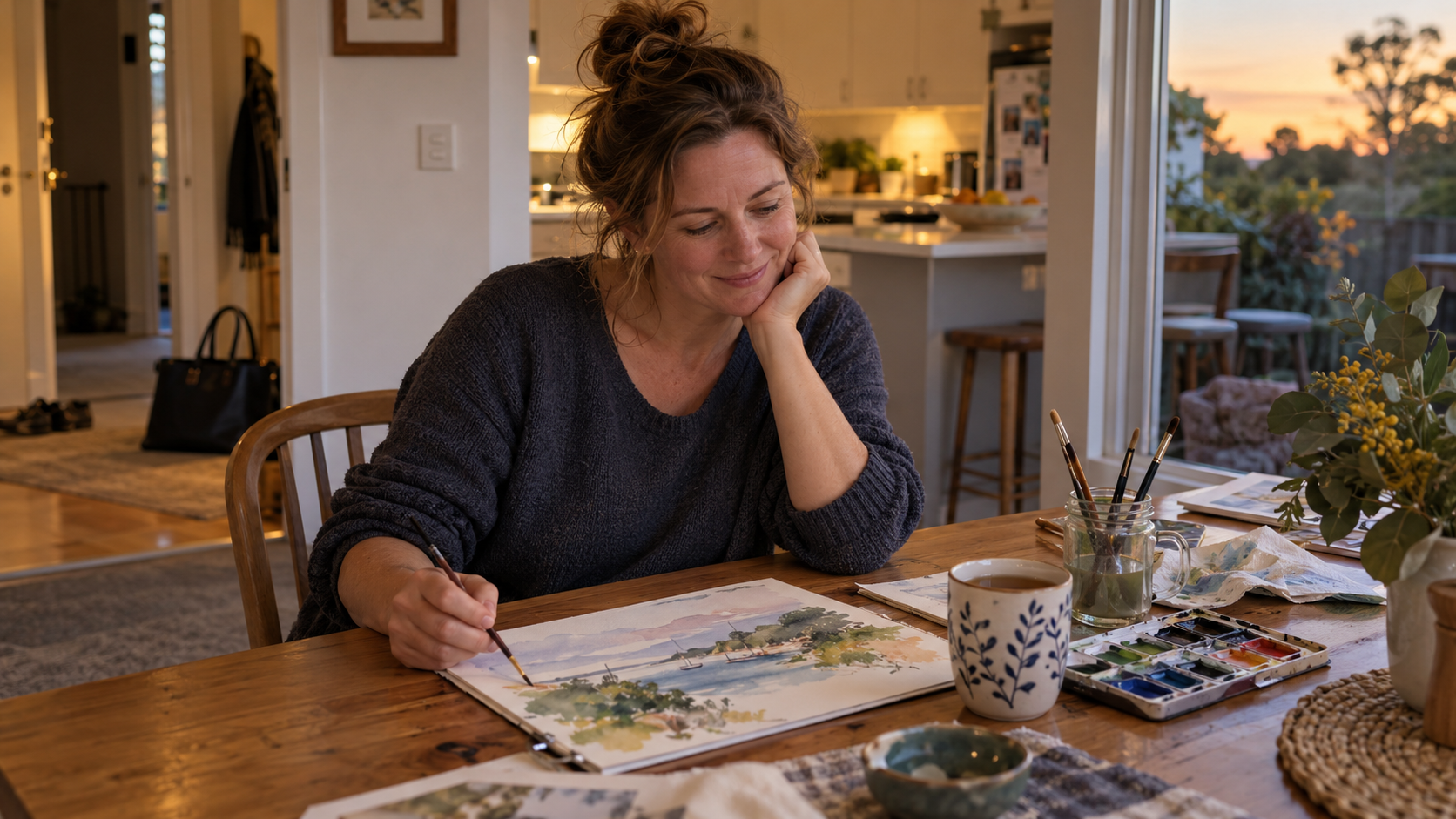
I recently started painting.
I am terrible.
Absolutely terrible.
I bought cheap paints and followed a video online.
The result looked nothing like what the woman in the video created.
My tree looked injured.
I almost threw it away.
Then I laughed.
And I kept it.
It is sitting in the spare room.
Nobody at school will ever see it.
I hope.
But I like it because it does not have to be good.
There is no rubric.
No performance indicator.
No meeting afterward.
Nobody says:
“Can we discuss areas for improvement?”
It is just a bad painting.
Mine.
I think I need things like that.
Things that belong to the person who does not have a position.
Maybe we all do.
I used to think work-life balance meant managing time properly.
Leave earlier.
Check fewer emails.
Take weekends.
Those things matter.
But now I think there is another part.
You have to maintain a self that knows what to do with the time once you have protected it.
Otherwise you create the boundary…
then fill the space with more school in your head.
That is where I am right now.
Trying to remember the person who exists after the office door closes.
What does she like?
Who does she call?
What makes her laugh?
What does she do badly and enjoy anyway?
What does she care about that has absolutely nothing to do with education?
I’m getting better at answering those questions.
Slowly.
I’m reading fiction again.
Not much.
Ten pages some nights.
Still counts.
I paint badly.
I have stopped checking email during dinner.
Mostly.
I let my partner tell stories without turning them into case conferences.
Progress.
And sometimes after work, before I go inside, I sit in the car for a minute.
But now I try not to use that minute to replay the day.
I ask myself:
What am I going home to?
Not what work is waiting tomorrow.
What is waiting now?
Dinner.
A book.
A person I love.
A bad painting.
An evening that does not need to accomplish anything.
That feels like a different question.
Maybe a better one.
I don’t want to spend my whole career waiting until retirement to become a person again.
That sounds harsh.
But I mean it.
I see how easily the job expands.
If you give it every available part of you, it will take them.
Not because the school is evil.
Because there is always more school.
Always.
The person after 5 PM has to be protected on purpose.
Nobody else can do that for me.
I think that is what I wanted to say.
I know who I am at school.
I’m still getting reacquainted with the woman who goes home afterward.
And I’m starting to think she deserves more than the leftovers.
So I’d like to ask The Good Principal something.
How do you stop the role from getting the best part of you while everyone else gets whatever energy remains?
And how do other school leaders reconnect with themselves after work when they have spent the whole day being needed by everybody else?
Because I don’t think I need a better evening routine.
I think I need to remember there is a person living inside those evenings.
Thank you for giving her somewhere to speak.
— Caroline
FROM THE GOOD PRINCIPAL’S OFFICE
Caroline, the line that stands out most is probably this one:
“I don’t want to spend my whole career waiting until retirement to become a person again.”
That is worth taking seriously.
Because school leadership can create a very subtle arrangement.
The school receives the most alert version of you.
The most patient.
The most prepared.
The most responsive.
The most useful.
Then home receives whoever is left.
That is not always avoidable.
Some days are simply exhausting.
But when it becomes the normal arrangement, something starts to feel off.
And I think you have already identified why.
The problem is not only time.
It is identity after responsibility.
You can protect two hours in the evening and still spend both hours mentally at school.
You can close the laptop and keep holding the meeting in your head.
You can silence email and still feel responsible for everything that might be happening.
That is why “leave work at work” often sounds much easier than it actually is.
The body leaves first.
The role sometimes takes longer.
You also named another difficult truth:
being needed can become familiar.
At school, usefulness is constant.
There is almost always evidence that you matter.
Someone needs a decision.
Someone needs reassurance.
Someone needs your signature.
Someone needs you to solve something.
Then you go home and nobody urgently needs you.
That should feel freeing.
Sometimes it feels strangely empty.
Not because your home life lacks meaning.
Because you have spent the entire day receiving very clear signals about your function.
Then those signals stop.
That is an adjustment.
And perhaps it explains why some leaders keep checking email when nothing actually requires checking.
The inbox gives you back the role.
There is something to answer.
You know who to be again.
That does not mean you secretly want more work.
It may simply mean the principal identity has become easier to access than the personal one.
The answer is probably not forcing yourself to “switch off” perfectly at 5 PM.
Human beings do not work like light switches.
It may be more useful to think about transition.
What helps your nervous system understand:
The part of the day where everything becomes my responsibility is over.
For some people that might be the drive home.
For someone else, changing clothes.
Walking.
Showering.
Cooking.
Ten minutes of silence.
Music.
Whatever marks the change.
But there is an important detail.
The transition should not only help you recover from school.
It should help you arrive somewhere else.
That distinction matters.
If the entire purpose of your evening is recovering so you can perform tomorrow, then tomorrow still owns the evening.
You said something similar yourself.
Exercise so you can handle stress.
Sleep so you can work better.
Socialize so you avoid burnout.
Rest so you can return refreshed.
Eventually even your private life becomes maintenance for your professional one.
You are allowed to reject that.
An evening can belong to you without having to improve Monday.
Your bad painting does not need to lower stress.
It does not need to develop creativity.
It does not need to make you a more reflective leader.
It can just be bad.
That may sound almost trivial.
It is not.
There is something psychologically important about having parts of your life where performance does not matter.
Leadership contains enormous amounts of evaluation.
Even when nobody is formally evaluating you, you are constantly assessing:
Was that decision right?
Did I handle that properly?
What needs improvement?
What happens next?
So an activity where the answer can simply be:
This is terrible and I enjoyed making it
has value.
Not because it serves the principal.
Because it belongs to Caroline.
You also mentioned bringing home the problem-solving reflex.
That is another common spillover.
Leadership trains you to hear a problem and immediately search for intervention.
At school, that is often useful.
At home, it can become exhausting for everyone.
Sometimes a person tells you something because they want connection, not management.
Your partner gave you a useful sentence:
“I don’t need you to solve it.”
That might be worth keeping.
Not as criticism.
As a cue.
The principal is not required here.
Caroline can just listen.
And there may be many other moments like that.
Nobody needs you to choose.
Nobody needs you to summarize.
Nobody needs the action plan.
Nobody needs the calmest person in the room.
Those are opportunities to practice a different way of existing.
Maybe one useful question after work is not:
“How do I switch off?”
but:
“What part of me gets to come forward now?”
The friend.
The partner.
The reader.
The terrible painter.
The person who laughs too loudly.
The person who does not know what to order.
The person who can lose the card game.
Those are not lesser versions of you.
They are the parts leadership does not always have room for.
And they need practice too.
There is another thing I would pay attention to:
Does home only receive your exhaustion?
If it does, perhaps this is not only about boundaries.
It may also be about where your energy is being spent during the school day.
No leader can preserve unlimited capacity.
But sometimes we give the school more than the role actually requires because we have become accustomed to total availability.
Every interruption gets access.
Every issue gets immediate attention.
Every emotion in the building becomes something we absorb.
Then we arrive home with nothing.
That is worth examining too.
Protecting the person after 5 PM may occasionally require protecting some of her energy before 5 PM.
Not answering everything instantly.
Not carrying every problem personally.
Taking lunch.
Letting someone else handle something they are capable of handling.
Leaving one task for tomorrow.
Small things.
Because the evening cannot restore endlessly what the day is allowed to consume without limit.
Still, I would resist turning this into another improvement project.
You do not need a twelve-step plan for becoming Caroline again.
You have already found signs that she is there.
The fiction.
The painting.
The card game.
The conversations where nothing needs fixing.
The quiet question in the car:
“What am I going home to?”
Keep that one.
It shifts the evening from absence to presence.
Not:
I am leaving school.
But:
I am going toward my life.
Those are different.
One is escape.
The other is return.
And maybe that is what the person after 5 PM really needs.
Not to be invented.
Not to be optimized.
Just returned to.
Regularly.
Before she becomes someone you only remember on holidays or after retirement.
The principal gets a large part of your life.
The position deserves seriousness.
The school deserves good leadership.
But it does not automatically deserve every remaining version of you.
Some parts can stay yours.
They should.
Share Your Thoughts